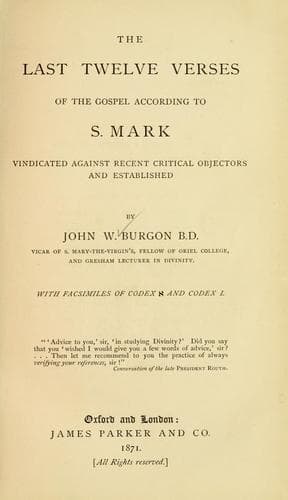
The Last Twelve Verses of the Gospel According to S. MarkBurgon, John William
Religion
The Last Twelve Verses of the Gospel According to S. Mark
Burgon, John William
Bible. Mark XVI, 9-20 -- Criticism, Textual
(9.) And now, shall I be thought unfair if, on a review of the premisses,
I assert that I do not see a shadow of reason for the imposing statement
which has been adopted by Tischendorf, Tregelles, and the rest, that
“there exist about thirty Codices which state that from the more ancient
and more accurate copies of the Gospel, the last twelve verses of S. Mark
were absent?” I repeat, there is not so much as _one single Codex_ which
contains such a scholion; while twenty-four(215) of those commonly
enumerated state _the exact reverse_.—We may now advance a step: but the
candid reader is invited to admit that hitherto the supposed hostile
evidence is on the contrary entirely _in favour_ of the verses under
discussion. (“I called thee to curse mine enemies, and, behold, thou hast
altogether blessed them these three times.”)
II. Nothing has been hitherto said about Cod. L.(216) This is the
designation of an uncial MS. of the viiith or ixth century, in the Library
at Paris, chiefly remarkable for the correspondence of its readings with
those of Cod. B and with certain of the citations in Origen; a peculiarity
which recommends Cod. L, (as it recommends three cursive Codices of the
Gospels, 1, 33, 69,) to the especial favour of a school with which
whatever is found in Cod. B is necessarily right. It is described as the
work of an ignorant foreign copyist, who probably wrote with several MSS.
before him; but who is found to have been wholly incompetent to determine
which reading to adopt and which to reject. Certain it is that he
interrupts himself, at the end of ver. 8, to write as follows:—
“_SOMETHING TO THIS EFFECT IS ALSO MET WITH_:
“All that was commanded them they immediately rehearsed unto Peter
and the rest. And after these things, from East even unto West,
did JESUS Himself send forth by their means the holy and
incorruptible message of eternal Salvation.
“_BUT THIS ALSO IS MET WITH AFTER THE WORDS, _‘FOR THEY WERE
AFRAID:’
“Now, when He was risen early, the first day of the week,”(217)
&c.
Public-domain text, read in full here on John Shaqi.
Reviews
Reviews
No reviews yet
Be the first to share your thoughts on this work.
Elsewhere in the archive
Join the Discussion
Join the discussion
Sign in to leave a comment or review.
Sign InorCreate an account