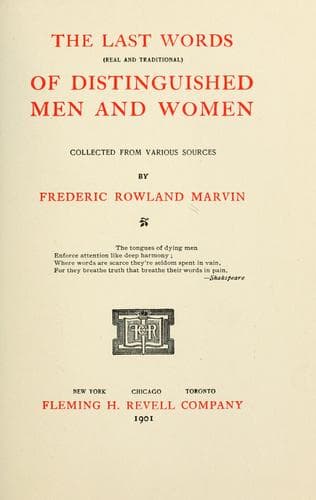
The Last Words (Real and Traditional) of Distinguished Men and WomenMarvin, Frederic Rowland
History
The Last Words (Real and Traditional) of Distinguished Men and Women
Marvin, Frederic Rowland
Last words
During the last nine days of his life he was constantly delirious. On
the morning of May 5th he uttered some incoherent words, among which
Montholon fancied that he distinguished, "_France ... armee ... tete
d'armee._" As the patient uttered these words he sprang from the bed,
dragging Montholon, who endeavored to restrain him, on the floor. It was
the last effort of that formidable energy. He was with difficulty
replaced in bed by Montholon and Archambault, and then lay quietly till
near six o'clock in the evening, when he yielded his last breath. A
great storm was raging outside, which shook the frail huts of the
soldiers as with an earthquake, tore up the trees that the Emperor had
planted, and uprooted the willow under which he was accustomed to
repose. Within, the faithful Marchand was covering the corpse with the
cloak which the young conqueror had worn at Marengo.
_Lord Rosebery._
[38] The heart of the first Napoleon had a narrow escape from
disappearing forever, elsewhere than in the tomb. It is recorded
that when he died at St. Helena his heart was extracted for
preservation. The English physician who had charge of it placed it
in a silver basin containing water, and leaving tapers burning
beside it retired to rest. Sleep, however, visited him not, and
suddenly, breaking the silence, he heard first a rustling, then a
plunge in the water of the basin, then a fall with a rebound on the
floor, all in quick succession. Springing from his couch, the
physician saw an enormous rat dragging Bonaparte's heart to its
hole: in a few moments more it would have formed a meal for rats.
NAPOLEON III. (Louis Napoleon, "The Little," "Ratipole," "The Man of
Sedan," "The Man of December," "Boustrapa," "Badinguet" and "The Comte
d'Arenenberg"), 1808-1873. "_Were you at Sedan?_" He asked the question
of Dr. Conneau. It was at Sedan that he surrendered his sword to the
King of Prussia.
NARES (Rev. Edward, "Thinks I to myself"), 1762-1841. "_Good-bye._"
NARUSZEWICZ (Adam Stanislas, "The Polish Tacitus"), 1733-1796. "_Must I
leave it unfinished?_" He referred to his "History of Poland."
NEANDER (Johann August, the celebrated church historian. He was of
Jewish descent, but early in life embraced the Christian faith, and at
his baptism assumed the name "Neander," from two Greek words signifying
a new man), 1789-1850. "_I am weary; I will now go to sleep. Good
night!_"
NELSON (Horatio), 1758-1805. "_Thank God, I have done my duty._" He died
in battle. Some say his last words were: "Kiss me, Hardy." Others give
them thus: "Tell Collingwood to bring the fleet to anchor."
Public-domain text, read in full here on John Shaqi.
Reviews
Reviews
No reviews yet
Be the first to share your thoughts on this work.
Elsewhere in the archive
Join the Discussion
Join the discussion
Sign in to leave a comment or review.
Sign InorCreate an account