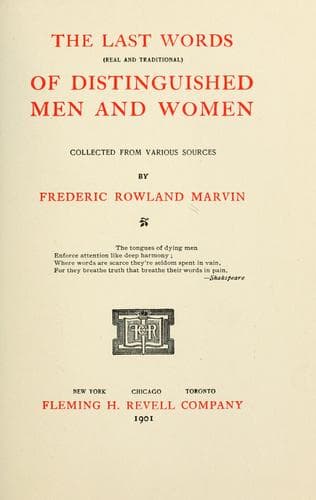
The Last Words (Real and Traditional) of Distinguished Men and WomenMarvin, Frederic Rowland
History
The Last Words (Real and Traditional) of Distinguished Men and Women
Marvin, Frederic Rowland
Last words
His ever-memorable signal to his fleet, immediately before the battle
commenced, had been; "England expects every man to do his duty," and if
ever a man lived and died in earnest, fearless, unselfish discharge of
his duty to his country, it was Admiral Nelson, victor of the Nile,
Copenhagen and Trafalgar.--_Appleton's Cyclopaedia of Biography._
NERO (Lucius Domitius Claudius Caesar, Emperor of Rome), 37-68. "_Qualis
artifex pereo!_"
The poor wretch who, without a pang, had caused so many brave Romans and
so many innocent Christians to be murdered, could not summon up
resolution to die. He devised every operatic incident of which he could
think. When even his most degraded slaves urged him to have sufficient
manliness to save himself from the fearful infamies which otherwise
awaited him, he ordered his grave to be dug, and fragments of marble to
be collected for its adornment, and water and wood for his funeral pyre,
perpetually whining: "What an artist to perish!" Meanwhile a courier
arrived for Phaon. Nero snatched his dispatches out of his hand, and
read that the Senate had decided that he should be punished in the
ancestral fashion as a public enemy. Asking what the ancestral fashion
was, he was informed that he would be stripped naked and scourged to
death with rods, with his head thrust into a fork. Horrified at this, he
seized two daggers, and after theatrically trying their edges, sheathed
them again, with the excuse that the fatal moment had not yet arrived!
Then he bade Sparus begin to sing his funeral song, and begged some one
to show him how to die. Even his own intense shame at his cowardice was
an insufficient stimulus, and he whiled away the time in vapid epigrams
and pompous quotations. The sound of horses' hoofs then broke on his
ears, and venting one more Greek quotation, he held the dagger to his
throat. It was driven home by Epaphroditus, one of his literary slaves.
At this moment the centurion who came to arrest him rushed in. Nero was
not yet dead, and under pretense of helping him, the centurion began to
stanch the wound with his cloak. "Too late," he said; "is this your
fidelity?" So he died; and the bystanders were horrified with the way in
which his eyes seemed to be starting out of his head in a rigid stare.
He had begged that his body might be burned without posthumous insults,
and this was conceded by Icelus, the freedman of Galba.
_Farrar: "Early Days of Christianity."_
It was the remark of Nero's father, Ahenobarbus, that nothing but what
was hateful and pernicious to mankind could ever come from Agrippina and
himself. Yet the story of a strange hand that strewed flowers upon the
tomb of this tyrant is well known.
NEWELL (Harriet, missionary in India), 1793-1812. "_The pains, the
groans, the dying strife. How long, O Lord, how long?_"
NEWPORT (Francis, once famous as an opponent of Christianity). "_Oh, the
insufferable pangs of hell and damnation!_" Died 1692.
Public-domain text, read in full here on John Shaqi.
Reviews
Reviews
No reviews yet
Be the first to share your thoughts on this work.
Elsewhere in the archive
Join the Discussion
Join the discussion
Sign in to leave a comment or review.
Sign InorCreate an account