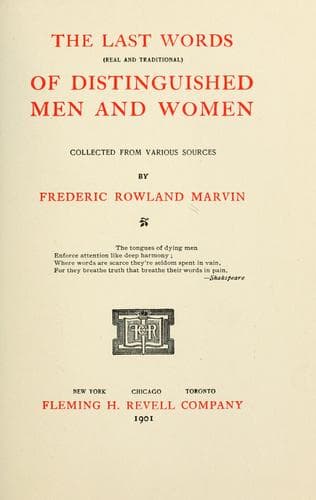
The Last Words (Real and Traditional) of Distinguished Men and WomenMarvin, Frederic Rowland
History
The Last Words (Real and Traditional) of Distinguished Men and Women
Marvin, Frederic Rowland
Last words
SEVERUS (Bishop of Ravenna),--390. "_My dear one, with whom I lived in
love so long, make room for me, for this is my grave, and in death we
shall not be divided._" The last words of Severus are purely
traditional.
Severus, Bishop of Ravenna, prepared a tomb for himself in his church.
In it he placed the bodies of his wife, Vincentia, and of his daughter,
Innocentia. After some years he was premonished that his time to die had
come. He held service with the people, dismissed them and closed the
cathedral doors. Then, clothed in his episcopal robes, with one
attendant, he went to the sepulchre of his family. They raised the stone
from the tomb, and Severus, looking in, said: "My dear one, with whom I
lived in love so long, make room for me, for this is my grave, and in
death we shall not be divided." Immediately he descended into the tomb,
laid himself down beside his wife and daughter, crossed his hands upon
his breast, looked up to heaven in prayer, gave one sigh and fell
asleep.
SHEPPARD (Jack, the noted highwayman, the hero of many a chap-book of
his day, and the hero and title of a novel by Defoe, and one by
Ainsworth), 1701-1724. "_I have ever cherished an honest pride; never
have I stooped to friendship with Jonathan Wild, or with any of his
detestable thief-takers; and though an undutiful son I never damned my
mother's eyes._"
Jack Sheppard was a popular idol followed by praise and applause even to
the gallows. "There was scarce a beautiful woman in London who did not
solace him during his prison hours with her condescension, and enrich
him with her gifts. Not only did the President of the Royal Academy
deign to paint his portrait, but (a far greater honor) Hogarth made him
immortal. Even the King displayed a proper interest, demanding a full
and precise account of his escapes. The hero himself was drunk with
flattery; he bubbled with ribaldry; he touched off the most valiant of
his contemporaries in a ludicrous phrase. But his chief delight was to
illustrate his prowess to his distinguished visitors, and nothing
pleased him better than to slip in and out of his chains."
Not a few of the highwaymen of the day were "gentlemen" and "coxcombs."
We have from Swift a picture of one such in his sketch of "Clever Tom
Clinch," who
While the rabble were bawling,
Rode stately through Holborn to die of his calling;
He stopped at the George for a bottle of sack,
And promised to pay for it--when he came back.
His waistcoat and stockings and breeches were white,
His cap had a new cherry ribbon to tie't:
And the maids at doors and the balconies ran
And cried "Lac-a-day! he's a proper young man!"
SHERIDAN (Richard Brinsley), 1751-1816. "_Did you know Burke?_" He
referred to Edmund Burke, the celebrated orator, statesman and
philosopher.
Public-domain text, read in full here on John Shaqi.
Reviews
Reviews
No reviews yet
Be the first to share your thoughts on this work.
Elsewhere in the archive
Join the Discussion
Join the discussion
Sign in to leave a comment or review.
Sign InorCreate an account