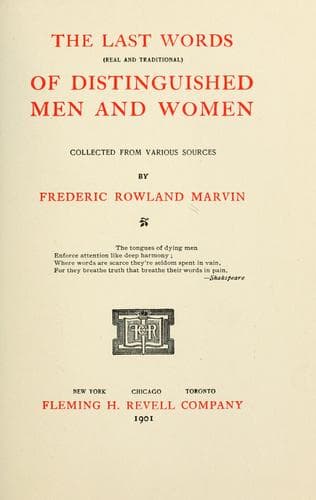
The Last Words (Real and Traditional) of Distinguished Men and WomenMarvin, Frederic Rowland
History
The Last Words (Real and Traditional) of Distinguished Men and Women
Marvin, Frederic Rowland
Last words
SHERMAN (John, distinguished American statesman, United States senator,
and secretary of state), 1823-1900. "_I think you had better send for
the doctor--I am so faint._"
At three o'clock yesterday morning, Mr. Sherman took a decided turn for
the worse. At that hour he complained of feeling faint and asked that
his physician be called. During the next hour the patient had several
fainting spells and during the day these continued at short intervals.
His doctor found him very weak and prescribed a stimulant, but the
medicine had very little effect, and the patient sank slowly. All day
his condition grew worse, but he retained consciousness till about nine
o'clock last night. From time to time, yesterday, Mr. Sherman attempted
to speak, but his words were not intelligible.
_Albany Evening Journal, Oct. 22, 1900._
SICKINGEN (Franz von, Protestant leader and a brave German soldier. He
championed the cause of learning and protected Ulrich von Hutten,
Reuchlin, and others from the rage and oppression of Romish
ecclesiastics), 1481-1523. "_I have already confessed my sins to God_,"
to his chaplain who inquired whether he desired to confess. He was
killed while defending his castle of Neustall.
SIDNEY (Algernon, English republican patriot), 1622-1683. "_Not till the
general resurrection: strike on!_" to the executioner who, asked him if
he would like to rise again, after laying his head on the block.
SIDNEY (Sir Philip, English gentleman, soldier and author), 1554-1586.
"_In me behold the end of the world with all its vanities._"
He was mortally wounded at Zutphen, September, 1586. After he was
wounded he called for some drink, which was brought, but before he had
tasted it, he gave the bottle to a wounded soldier, saying, "Thy
necessity is greater than mine."
SMALRIDGE (George, Bishop of Bristol), 1663-1719. "_God be thanked, I
have had a very good night._"
SMITH (Joseph, founder and first prophet of the Mormon Church),
1805-1844. "_That's right, Brother Taylor; parry them off as well as you
can_," to the Mormon Apostle John Taylor who was defending Smith and
endeavoring to drive back the mob.
Smith amassed a large fortune, assumed the title of lieutenant-general
and president of the church, and exercised absolute authority over his
"saints." He provoked the popular indignation by attempts to seduce the
wives of other men, and was arrested and confined in jail at Carthage.
In June, 1844, a mob broke into the jail and killed Joseph Smith.
_Lippincott's Biographical Dictionary._
"I was sitting at one of the front windows of the jail, when I saw a
number of men, with painted faces, coming round the corner of the jail
and aiming toward the stairs.
Public-domain text, read in full here on John Shaqi.
Reviews
Reviews
No reviews yet
Be the first to share your thoughts on this work.
Elsewhere in the archive
Join the Discussion
Join the discussion
Sign in to leave a comment or review.
Sign InorCreate an account