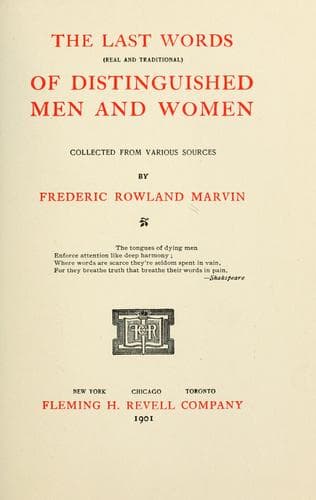
The Last Words (Real and Traditional) of Distinguished Men and WomenMarvin, Frederic Rowland
History
The Last Words (Real and Traditional) of Distinguished Men and Women
Marvin, Frederic Rowland
Last words
A few hours before Sumner died Judge Hoar gave him a message from Ralph
Waldo Emerson, to which Sumner replied with some difficulty, "Tell
Emerson that I love and revere him." Over and over again he said to
Judge Hoar, "Do not let the Civil Rights bill fail!" To the last his
mind was engaged upon the great problems of national interest that had
occupied him during all the stormy days of the Civil War.
[44] Rupture of the heart, it is believed, was first described by
Harvey; but since his day several cases have been observed. Morgagni
has recorded a few examples: Amongst them that of George II., who
died suddenly, of this disease in 1760; and, what is very curious,
Morgagni himself fell a victim to the same malady. Dr. Elliotson, in
his Lumleyan Lecture on Diseases of the Heart, in 1839, stated that
he had only seen one instance; but in the Cyclopaedia of Practical
Medicine, Dr. Townsend gives a table of twenty-five cases, collected
from various authors. Generally this accident is consequent upon
some organic disease, such as fatty degeneration; but it may arise
from violent muscular exertion, or strong mental emotions.--_Welby:
"Mysteries of Life, Death and Futurity."_
Dr. William Stroud endeavors to prove, in his "The Physical Cause of
the Death of Christ," that our Saviour died upon the cross from
rupture of the heart, produced by agony of mind. He says: "In the
garden of Gethsemane Christ endured mental agony so intense that,
had it not been limited by divine interposition, it would probably
have destroyed his life without the aid of any other sufferings; but
having been thus mitigated, its effects were confined to violent
palpitation of the heart, accompanied with bloody sweat. On the
cross this agony was renewed, in conjunction with the ordinary
sufferings incidental to that mode of punishment; and having at this
time been allowed to proceed to its utmost extremity without
restraint, occasioned sudden death by rupture of the heart,
intimated by a discharge of blood and water from his side, when it
was afterward pierced with a spear."
SVETCHINE, or SWETCHINE (Sophia Soymonof, a Russian lady and writer),
1782-1857. Madame Svetchine's last words were, "_It will soon be time
for mass. They must raise me._" She was a most devoted Roman Catholic.
SWARTZ (Frederick Christian, Missionary in India), 1726-1798. "_Had it
pleased my Lord to spare me longer I should have been glad. I should
then have been able to speak yet a word to the sick and poor; but His
will be done! May He, in mercy, but receive me! Into Thy hands I commend
my spirit; Thou hast redeemed me, O Thou faithful God._" After this his
Malabar helpers sang a portion of a hymn and he endeavored to sing with
them, but his strength failing, he soon expired in the arms of a native
Christian.
Public-domain text, read in full here on John Shaqi.
Reviews
Reviews
No reviews yet
Be the first to share your thoughts on this work.
Elsewhere in the archive
Join the Discussion
Join the discussion
Sign in to leave a comment or review.
Sign InorCreate an account