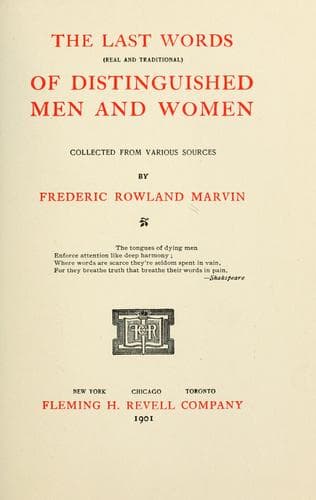
The Last Words (Real and Traditional) of Distinguished Men and WomenMarvin, Frederic Rowland
History
The Last Words (Real and Traditional) of Distinguished Men and Women
Marvin, Frederic Rowland
Last words
SWEDENBORG (Emanuel, Swedish seer, philosopher and theologian),
1688-1772. "_It is well; I thank you; God bless you._" He told the
Shearsmiths on what day he should die; and the servant remarked: "He
was as pleased as I should have been if I was to have a holiday, or was
going to some merry-making."
His faculties were clear to the last. On Sunday afternoon, the 29th day
of March, 1772, hearing the clock strike, he asked his landlady and her
maid, who were both sitting at his bed-side, what o'clock it was; and
upon being answered it was five o'clock, he said--"It is well; I thank
you; God bless you;" and a little after, he gently departed.[45]
_White's "Life and Writings of Swedenborg."_
[45] Swedenborg was buried in the vault of the Swedish Church in
Prince's Square, on April 5, 1772. In 1790, in order to determine a
question raised in debate, viz., whether Swedenborg was really dead
and buried, his wooden coffin was opened, and the leaden one was
sawn across the breast. A few days after, a party of Swedenborgians
visited the vault. "Various relics" (says White: "_Life of
Swedenborg_," 2nd ed., 1868, p. 675) "were carried off: Dr. Spurgin
told me he possessed the cartilage of an ear. Exposed to the air,
the flesh quickly fell to dust, and a skeleton was all that remained
for subsequent visitors.... At a funeral in 1817, Granholm, an
officer in the Swedish Navy, seeing the lid of Swedenborg's coffin
loose, abstracted the skull, and hawked it about amongst London
Swedenborgians, but none would buy. Dr. Waehlin, pastor of the
Swedish Church, recovered what he supposed to be the stolen skull,
had a cast of it taken, and placed it in the coffin in 1819. The
cast which is sometimes seen in phrenological collections is
obviously not Swedenborg's: it is thought to be that of a small
female skull."
SWIFT (Jonathan, Dean of Saint Patrick's, Dublin, and author of "The
Tale of a Tub," and "Travels of Lemuel Gulliver"), 1667-1745. "_It is
folly; they had better leave it alone_," to his house-keeper who
informed him that the usual bonfires and illuminations were preparing to
do honor to his birthday. Some say his last words were, "_Ah, a German!
a prodigy, admit him!_" spoken as Handel was announced.
TALLEYRAND-PERIGORD (Charles Maurice, celebrated French diplomatist),
1754-1838, "_I am suffering, sire, the pangs of the damned._" Said to
the king, Louis Phillippe, who enquired his condition.
Louis Blanc (_Histoire de Dix Ans. v. 290_) says that when Louis
Philippe called upon Talleyrand during that prince's last hours, he
enquired if he suffered: "_Yes, comme un damne_," answered Talleyrand;
at which the king said under his breath, "What, already?" (Quoi, deja?)
TALMA (Francois Joseph, "The Garrick of the French Stage"), 1770-1826.
"_The worst is I can not see._"
Public-domain text, read in full here on John Shaqi.
Reviews
Reviews
No reviews yet
Be the first to share your thoughts on this work.
Elsewhere in the archive
Join the Discussion
Join the discussion
Sign in to leave a comment or review.
Sign InorCreate an account