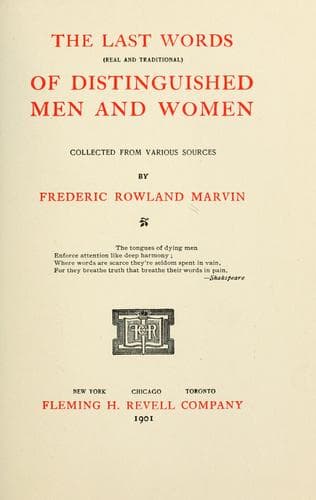
The Last Words (Real and Traditional) of Distinguished Men and WomenMarvin, Frederic Rowland
History
The Last Words (Real and Traditional) of Distinguished Men and Women
Marvin, Frederic Rowland
Last words
[46] Being asked by the sheriff to explain these words, he said: "I
am as you see, a man that hath a very great carcass, which I thought
should have been buried in Hadley churchyard, if I had died in my
bed, as I well hoped I should have done. But herein I see I was
deceived. And there are a great number of worms in Hadley
churchyard, which should have had jolly feeding upon this carrion
which they have looked for many a day. But now I know we be
deceived, both I and they; for this carcass must be burnt to ashes,
and so shall they lose their bait and feeding that they looked to
have had of it." Fox, the martyrologist, adds that, "when the
sheriff and his company heard these words they were amazed, and
looked at one another, marvelling at the man's constant mind, that
thus without all fear made but a jest at the cruel torment and death
now at hand prepared for him."
TAYLOR (Zachary, American general and twelfth President of the United
States), 1784-1850. "_I am about to die. I expect the summons soon. I
have endeavored to discharge all my official duties faithfully. I regret
nothing, but am sorry that I am about to leave my friends._"
TENDERDEN (Lord), "_Gentlemen of the jury, you will now consider of your
verdict._"
TENNENT (William, Pastor of Presbyterian Church in Freehold, N. J. His
name has been rendered famous by his peculiar experience which at the
time attracted the attention of the entire country. During an attack of
fever, he fell into a trance which continued three days. He was supposed
to be dead, and was prepared for burial; but suddenly he recovered, and
gave a description of what he had seen in the Heavenly world. He never
doubted to the last day of his life that he had seen the New Jerusalem
during the three days of his trance. Elias Boudinot published a
circumstantial account of the wonderful vision), 1705-1777. "_I am
sensible of the violence of my disorder, and that it is accompanied with
symptoms of approaching dissolution; but, blessed be God, I have no wish
to live, if it should be His will to call me hence._"
TENNYSON (Alfred, Lord, Poet-laureate of England), 1809-1892. "_I have
opened it._" These are the last words of the poet that have been made
public; later he bade his family farewell, but what he said has never
been published.
His last food was taken at a quarter of four, and he tried to read, but
could not. He exclaimed, "I have opened it." Whether this referred to
the Shakspeare, opened by him at
Hang there like fruit, my soul,
Till the tree die,
which he always called among the tenderest lines in Shakspeare, or
whether one of his last poems, of which he was fond, was running through
his head I cannot tell:
Fear not, thou, the hidden purpose of that Power
Which alone is great,
Nor the myriad world, his shadow, nor the silent
Opener of the Gate.
He then spoke his last words, a farewell blessing to my mother and
myself.
Public-domain text, read in full here on John Shaqi.
Reviews
Reviews
No reviews yet
Be the first to share your thoughts on this work.
Elsewhere in the archive
Join the Discussion
Join the discussion
Sign in to leave a comment or review.
Sign InorCreate an account