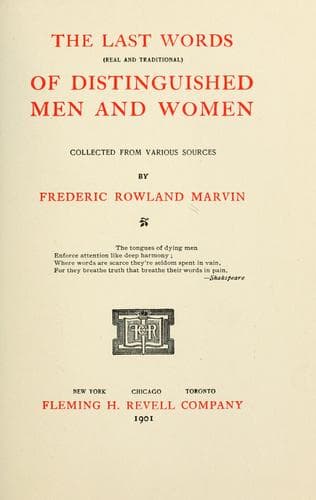
The Last Words (Real and Traditional) of Distinguished Men and WomenMarvin, Frederic Rowland
History
The Last Words (Real and Traditional) of Distinguished Men and Women
Marvin, Frederic Rowland
Last words
For the next hours the full moon flooded the room and the great
landscape outside with light; and we watched in solemn stillness. His
patience and quiet strength had power upon those who were nearest and
dearest to him; we felt thankful for the love and the utter peace of it
all; and his own lines of comfort from "_In Memoriam_" were strongly
borne in upon us. He was quite restful, holding my wife's hand, and, as
he was passing away, I spoke over him his own prayer, "God accept him!
Christ receive him!" because I knew that he would have wished it.
_Alfred, Lord Tennyson, a Memoir by his son._
TERCHOUT (Adele--"La Comete"). The gay and thoughtless life of this
beautiful young woman ended in sad regrets and bitter remembrances, and
yet there is some slight hope that there was with her at last a thought
real, if not deep, of better things.
Does any one remember a beautiful girl who went by the nickname of "La
Comete," and flashed through the Parisian world during the last year of
the Second Empire? She was called "Comet" on account of the exceeding
length and loveliness of her golden hair. Theophile Gautier wrote a
sonnet to her, Cabanel painted her portrait. Worth dressed her, and Leon
Cugnot took her as the model of his statue, "La Baigneuse." Her real
name was Adele Terchout, and just before the Franco-German war broke out
she declined an offer of marriage from an elderly duke, with a very
ancient escutcheon. At that time she owned one of the finest mansions in
the Champs Elysees, had twelve horses in her stables and a bushel of
diamonds in her dressing-case. Last week this dazzling creature died in
a Parisian hospital absolutely destitute, and the disease which carried
her off was the most hideous that could befall a pretty woman--a lupus
vorax, or cancer in the face, which totally disfigured her. Like Zola's
"Nana," the only vestige left of her beauty when she died was her
matchless hair, which measured nearly five feet.
_London Truth._
THEOPHRASTUS (eminent Greek philosopher. He was a favorite pupil of
Aristotle whom he succeeded as President of the Lyceum B. C. 322), about
B. C. 374-286. This philosopher's last words are not recorded, but on
his death-bed he accused Nature of cruelty. He charged her with
having-given a long life to stags and crows, and only a short one to men
and women who are so much better able to use for their own good and that
of others length of days. He declared that human beings needed long life
for the perfection of art. He complained that as soon as he had begun to
perceive the beauty of the world he was called upon to die.[47]
[47] Thus also did Themistocles, the most renowned of Grecian
generals, grieve that when he had acquired the wisdom necessary for
a useful life, it was time to die.
Public-domain text, read in full here on John Shaqi.
Reviews
Reviews
No reviews yet
Be the first to share your thoughts on this work.
Elsewhere in the archive
Join the Discussion
Join the discussion
Sign in to leave a comment or review.
Sign InorCreate an account