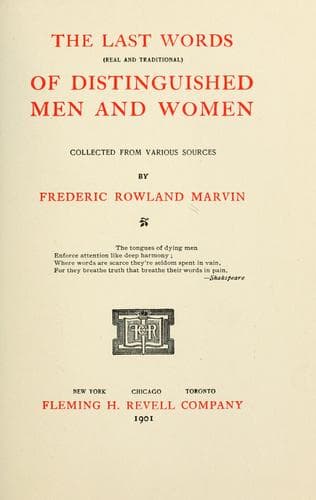
The Last Words (Real and Traditional) of Distinguished Men and WomenMarvin, Frederic Rowland
History
The Last Words (Real and Traditional) of Distinguished Men and Women
Marvin, Frederic Rowland
Last words
Upon a visit to Megara, a town in the neighborhood of Athens, he was
seized with a languor, which increased during the ensuing voyage; and he
expired a few days after landing at Brundisium, on the 22d of September
in the fifty-second year of his age. He desired that his body might be
carried to Naples, where he had passed many happy years; and that the
following distich, written in his last sickness, should be inscribed
upon his tomb:
Mantua me genuit: Calabri rapuere, tenet nunc
Parthenope, Cecerie pascua, rura, duces.
VITELLIUS (Aulus, Emperor of Rome), 15-69. "_Yet I was once your
emperor_," to the soldiers of Vespasian who were putting him to death by
a lingering torture whilst they were dragging him by a horse into the
Tiber.
VOLTAIRE (a name capriciously assumed by Francois Marie Arouet, and made
by him more celebrated than any other of which we read in the literary
history of the eighteenth century), 1694-1778. "_Adieu my dear Marand; I
am dying_," said to his valet.
According to a document discovered by Mr. Schuyler, American Consul at
Moscow, bearing on the death of Voltaire, and which was forwarded to M.
Taine, and published in the _Journal des Debats_, the last words of
Voltaire were, "Take care of Maria," meaning his niece, Madame Denys.
These words were addressed to one of his servants.
It has also been said that his last words were: "For the love of God,
don't mention that Man--allow me to die in peace!" to one who called his
attention to our Saviour.
There are several widely divergent accounts of the last hours of
Voltaire, and perhaps it is not possible to know just what measure of
truth is to be found in any one of them. It is said that on his
death-bed he cursed D'Alembert and denounced his infidel associates;
that he made in the presence of Abbe Gaultier, the Abbe Mignot, and the
Marquis de Villeveille a declaration of his wish to be reconciled to
"the church;" that he spent much time in alternately praying and
blaspheming. These facts, if facts they really are, rest upon the
statements of Mons. Tronchin, the Protestant physician from Geneva, who
attended him almost to the last, and who was so horrified at what he
witnessed that he said, "_Pour voir toutes les furies d'Oreste, il n'y
avait qu'a se trouver a la mort de Voltaire._" The Marechal de
Richelieu, also, was terrified at what he saw and heard, and left the
bed-side of Voltaire declaring that his nerves were not strong enough to
endure the strain. Tronchin's statements are denied by Vilette and
Monke, who represent the last hours of the great Frenchman as calm and
peaceful. The exact truth will, it is most likely, never be known beyond
all question, and yet, to the compiler of this book, the weight of
evidence seems to be with Tronchin rather than with those who have
impeached his testimony.
Public-domain text, read in full here on John Shaqi.
Reviews
Reviews
No reviews yet
Be the first to share your thoughts on this work.
Elsewhere in the archive
Join the Discussion
Join the discussion
Sign in to leave a comment or review.
Sign InorCreate an account