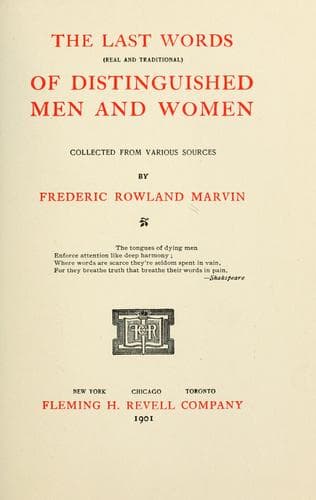
The Last Words (Real and Traditional) of Distinguished Men and WomenMarvin, Frederic Rowland
History
The Last Words (Real and Traditional) of Distinguished Men and Women
Marvin, Frederic Rowland
Last words
WAGNER (Richard Wilhelm, German composer, among whose works are
"Rheingold," "Valkyria," "Siegfried" and "The Twilight of the Gods"),
1813-1883. "_Mir ist sehr schlecht._"
At three o'clock he went to dinner with the family, but just as they
were assembled at table and the soup was being served he suddenly sprang
up, cried out, "Mir ist sehr schlecht (I feel very bad)," and fell back
dead from an attack of heart disease.
WALLER (Edmund, English poet), 1605-1687. He died repeating lines from
Virgil.
WARHAM (William, Archbishop of Canterbury), 1450-1532. "_That is enough
to last till I get to Heaven._" Said to his servant who told him he had
still left thirty pounds.
WARNER (Charles Dudley, author and lecturer), 1829-1900. "_I am not
well, and should like to lie down--will you call me in ten minutes?
Thank you. You are very kind--in ten minutes--remember!_"
Among Mr. Warner's acquaintances was a colored man, to whom he gave
books to encourage his desire to read, particularly books connected
with the history of the colored race, upon which Mr. Warner was an
authority.
Mr. Warner probably intended to call on this man, as he was in the
neighborhood of his house when he was stricken. Feeling ill, he asked
permission at a house to sit down, then to lie down, requesting to be
called in ten minutes. When the woman of the house went to call him he
was dead.
WASHINGTON (George, "the Father of His Country,"[51] and the first
President of the United States), 1732-1799. "_It is well._" Some say his
last words were, "I am about to die, and I am not afraid to die."
Washington said to Mr. Lear, his secretary. "I am just going; have me
decently buried, and do not let my body be put into the vault until
three days after I am dead--do you understand me?" On his secretary's
replying that he did, the dying man added, "It is well." About an hour
later he quietly withdrew his hand from Mr. Lear's, and felt his own
pulse, and immediately expired without a struggle.
A coffin of mahogany, lined with lead and covered within and without
with black velvet, was made on the following day at Alexandria. On a
plate at the head of the coffin was inscribed "_Surge ad Judicium_;" on
another, in the middle, "_Gloria Deo_," while on a small silver plate in
the form of an American shield appeared the inscription:
GEORGE WASHINGTON.
BORN FEB. 22, 1732.
DIED DEC. 14, 1799.
His body was first placed in the family vault on the Mount Vernon
estate. In his will, Washington left directions and plans for a new
vault, which was built afterward, and to which his remains were
transferred in 1832. The front of his tomb has an ante-chamber, built of
red brick, about twelve feet in height, with a large iron gateway. It
was erected for the accommodation of two marble coffins, or sarcophagi,
one for Washington, the other for Mrs. Washington; they stand in full
view of the visitor. Over the gateway, upon a marble slab, are the
words:
Public-domain text, read in full here on John Shaqi.
Reviews
Reviews
No reviews yet
Be the first to share your thoughts on this work.
Elsewhere in the archive
Join the Discussion
Join the discussion
Sign in to leave a comment or review.
Sign InorCreate an account