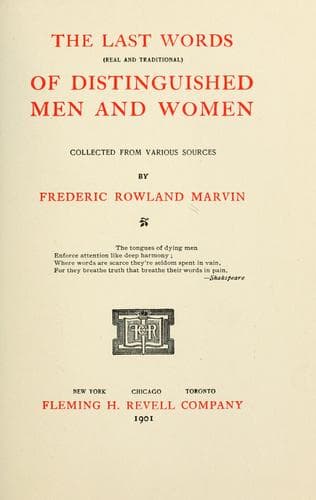
The Last Words (Real and Traditional) of Distinguished Men and WomenMarvin, Frederic Rowland
History
The Last Words (Real and Traditional) of Distinguished Men and Women
Marvin, Frederic Rowland
Last words
Being satisfied on this point, and that he should, therefore, have a
final warning, he said a moment afterwards, "I will, then, put myself in
a position to obtain a little repose." In this he was successful. He had
intervals of rest to the last; but on rousing from them he showed that
he was still intensely anxious to preserve his consciousness, and to
watch for the moment and act of his departure, so as to comprehend it.
Awaking from one of these slumbers, late in the night, he asked
distinctly if he were alive, and on being assured that he was, and that
his family was collected around his bed, he said in a perfectly natural
tone, as if assenting to what had been told him, because he himself
perceived that it was true, "I still live." These were his last coherent
and intelligible words. At twenty-three minutes before three o'clock,
without a struggle or a moan, all signs of life ceased to be visible.
--_Louis Gaylord Clark._
[52] The United States has produced no greater orator than Daniel
Webster; nevertheless, in the minds of many, he fell from his most
exalted station as the interpreter of the public conscience, when he
delivered, March 7, 1850, his famous speech, assenting to the
Fugitive Slave Law. It was this speech that called forth Whittier's
poem "Ichabod," which has been often compared with Browning's "Lost
Leader."
WEBSTER (Thomas, Professor of Geology in the London University, and
author of "Encyclopaedia of Domestic Economy"), 1773-1844. "_Examine it
for yourself._"
WEBSTER (William, English clergyman and author of "The Life of General
Monk"), 1689-1758. "_Peace._"
WEED (Thurlow, American journalist and politician. He wrote "Letters
from Europe and the West Indies," and for many years edited with marked
ability, "_The Albany Evening Journal_"), 1797-1882. "_I want to go
home._"
During his last hours his mind wandered, and he thought himself in
conversation with President Lincoln and General Scott with regard to the
Southern Confederacy.
WESLEY (Charles, English hymn-writer whose sacred songs are sung, in
original or translation, all over the Christian world. He is the author
of "Love divine, all love excelling," "Jesus, lover of my soul," and
"Christ, the Lord, is risen to-day"), 1708-1788. "_I shall be satisfied
with Thy likeness--satisfied!_"
WESLEY (John, founder of the Methodist Episcopal Church), 1703-1791.
"_The best of all is God is with us._"
Public-domain text, read in full here on John Shaqi.
Reviews
Reviews
No reviews yet
Be the first to share your thoughts on this work.
Elsewhere in the archive
Join the Discussion
Join the discussion
Sign in to leave a comment or review.
Sign InorCreate an account