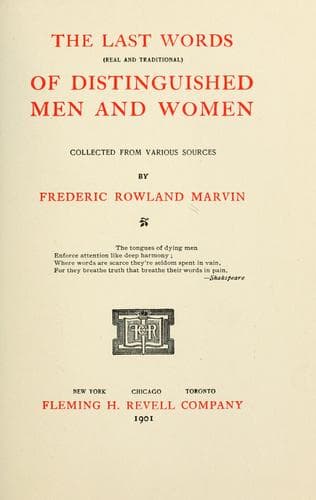
The Last Words (Real and Traditional) of Distinguished Men and WomenMarvin, Frederic Rowland
History
The Last Words (Real and Traditional) of Distinguished Men and Women
Marvin, Frederic Rowland
Last words
"Within this enclosure rest the remains of General GEORGE
WASHINGTON."
Over the vault door inside, are the words:
"HE THAT BELIEVETH IN ME, THOUGH HE WERE DEAD, YET SHALL HE
LIVE AGAIN."
Napoleon, who was then First Consul of the French, issued the following
order under date of February 18, 1800: "Washington is no more! That
great man fought against tyranny. He firmly established the liberty of
his country. His memory will be ever dear to the French people, as it
must be to every friend of freedom in the two worlds, and especially to
the French soldiers, who, like him and the Americans, bravely fight for
liberty and equality. The First Consul in consequence orders that, for
ten days, black crepes shall be suspended to all the standards and flags
of the Republic."
[51] "And Meonothai begat Ophrah: and Seraiah begat Joab, _the
father of the Valley of Charashim_; for they were craftsmen."--_1
Chronicles iv: 14_; Julius Caesar was called the Father of his
country; Cosmo de Medici is so described on his tombstone; Andrea
Doria has upon his statue at Genoa, _Pater Patriae_; and Louis XVIII.
of France was commonly called the Father of the Country.
WATTS (Isaac, English divine and sacred poet. He is the author of many
beautiful and popular hymns), 1674-1748. "_It is a great mercy to me
that I have no manner of fear or dread of death. I could, if God please,
lay my head back and die without terror this afternoon._"
WEBSTER (Daniel), 1782-1852. "_I still live!_" This was his last
coherent utterance. Later he muttered something about poetry, and his
son repeated to him one of the stanzas of "Gray's Elegy." He heard it
and smiled.[52]
He inquired whether it were likely that he should again eject blood
from his stomach before death, and being told that it was improbable, he
asked, "Then what shall you do?" Being answered that he would be
supported by stimulants, and rendered as easy as possible by the opiates
that had suited him so well, he inquired, at once, if the stimulant
should not be given immediately; anxious again to know if the hand of
death were not already upon him. And on being told that it would not be
then given, he replied, "_When_ you give it to me, I shall know that I
may drop off at once."
Public-domain text, read in full here on John Shaqi.
Reviews
Reviews
No reviews yet
Be the first to share your thoughts on this work.
Elsewhere in the archive
Join the Discussion
Join the discussion
Sign in to leave a comment or review.
Sign InorCreate an account