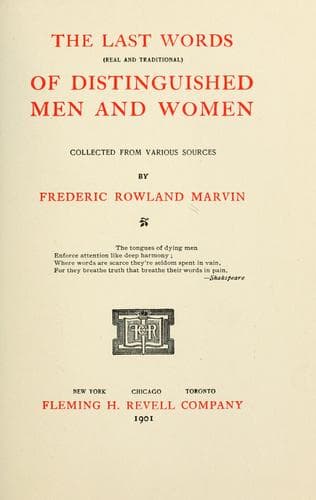
The Last Words (Real and Traditional) of Distinguished Men and WomenMarvin, Frederic Rowland
History
The Last Words (Real and Traditional) of Distinguished Men and Women
Marvin, Frederic Rowland
Last words
"David Hume pronounced Whitefield the most ingenious preacher he had
ever heard, and said it was worth while to go twenty miles to hear him.
But perhaps the greatest proof of his persuasive powers was when he drew
from Benjamin Franklin's pocket the money which that clear, cool
reasoner had determined not to give."--_Robert Southey._
WHITMAN (Walt, American poet and army nurse), 1819-1892. "_O, he's a
dear, good fellow_," said of Thomas Donaldson, one of his most
enthusiastic friends, and later his biographer.
There was a most pathetic incident connected with Mr. Whitman's death.
It was related to me by "Warry" Fritzinger, his nurse. Warry had
arranged a rope above Mr. Whitman's head, in the bed, which was attached
to a bell below. He would pull this rope after he became weak, and thus
ring the bell to attract attention. Prior to this time he had used his
heavy cane to pound the floor with. This brought assistance at once.
Just before he died, as the great change came over him--he was conscious
that it was a great change, a something unusual (Mrs. Davis and Warry
were by his side)--he seemed as if groping for something. Death had
called for him, and as the call came, he attempted to reach above his
head with one of his hands and feel for the rope, as if to call for
help. In an instant the arm dropped, and soon he was dead.
_Donaldson: "Walt Whitman the Man."_
Whitman has, amid the fleshly and physical poems, much that is deeply
spiritual; amid the tuneless and formless, much noble thought fitly
voiced. The higher mood and the higher work may be seen in "O Captain!
my Captain!" "Reconciliation," "Vigil on the Fields," "The City
Dead-House," "Song of the Broad Axe," "Proud Music of the Storm," "The
Mystic Trumpeter," "Seashore Memories," and the death-carols of the
"Passage to India."
_Welsh: "Digest of English and American Literature."_
WHITTIER (John Greenleaf, distinguished American poet), 1807-1892. "_I
have known thee all the time_," to his niece in response to her
question, "Do you know me?"
Others say his last words were, "Give my love to the world."
Public-domain text, read in full here on John Shaqi.
Reviews
Reviews
No reviews yet
Be the first to share your thoughts on this work.
Elsewhere in the archive
Join the Discussion
Join the discussion
Sign in to leave a comment or review.
Sign InorCreate an account