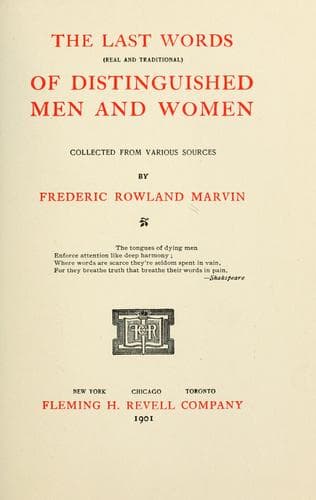
The Last Words (Real and Traditional) of Distinguished Men and WomenMarvin, Frederic Rowland
History
The Last Words (Real and Traditional) of Distinguished Men and Women
Marvin, Frederic Rowland
Last words
Upon the silver coffin-plate was the inscription: "John Greenleaf
Whittier, December 17, 1807, September 7, 1892." The face of the dead
man wore an expression of peace and perfect repose. All around his head
and body was a delicate fringe of maidenhair fern. Directly over his
breast was a superb wreath of white roses, carnations and maidenhair
ferns from that other loved poet and dear friend, for whom Whittier
wrote his last poem, Dr. Oliver Wendell Holmes. Upon the lid was a
cluster of white carnations from Mrs. Elizabeth Stuart Phelps Ward, and
at the foot were two crossed palms with white lilies. At the last were
roses and maidenhair ferns. A broad white satin ribbon encircled the
palms and sprays, and upon the ends, delicately painted, were the
inscriptions: "In memory of John Greenleaf Whittier, September 7, 1892,"
and this verse:
"Some sweet morning, yet in God's
Dim aeonian periods,
Joyful I shall wake to see
Those I love, who rest in Thee.
And to them, in Thee allied,
Shall my soul be satisfied."
Upon the card were these words: "In memoriam of my husband's dear
friend. This verse of Andrew Rykman's prayer was used for consolation by
him who wrote it in the hour of death. Mrs. Daniel Lathrop."
_N. Y. Tribune, September 12, 1892._
WIELAND (Christoph Martin, celebrated German poet, first translator of
Shakspeare's works into the German language, founder and editor of the
"Deutscher Mercur." His most celebrated poem is "Oberon"), 1733-1813.
"_To sleep--to die._"
WILBERFORCE (William, British statesman and philanthropist), 1759-1833.
"_Heaven!_" Some say his last words were: "I now feel so weaned from
earth, my affections so much in heaven, that I can leave you all without
regret; yet I do not love you less, but God more."
WILD (Jonathan, noted highwayman, the hero of many a chap-book of his
day, and the hero and title of a novel by Fielding), 1682-1725. "_Lord
Jesus receive my soul!_" Unfortunately there is some doubt as to the
genuineness of these pious words, for they come to us through the
chaplain of the prison, Rev. Thomas Pureney, a man of whom we have this
description in Charles Whibley's "Book of Scoundrels:"
"Pureney yielded without persuasion to the pleasures denied his cloth.
There was ever a fire to extinguish at his throat, nor could he veil his
wanton eye at the sight of a pretty wench. Again and again the lust of
preaching urged him to repent, yet he slid back upon his past gaiety,
until 'Parson Pureney' became a by-word. Dismissed from Newmarket in
disgrace, he wandered the country up and down in search of a pulpit, but
so infamous became the habit of his life that only in prison could he
find an audience fit and responsive."
WILLARD (Frances Elizabeth, American reformer and temperance advocate),
1839--. "_How beautiful to be with God._"
Public-domain text, read in full here on John Shaqi.
Reviews
Reviews
No reviews yet
Be the first to share your thoughts on this work.
Elsewhere in the archive
Join the Discussion
Join the discussion
Sign in to leave a comment or review.
Sign InorCreate an account