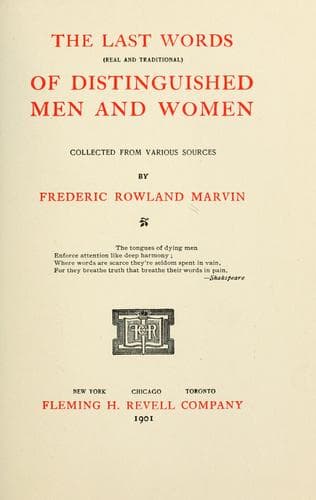
The Last Words (Real and Traditional) of Distinguished Men and WomenMarvin, Frederic Rowland
History
The Last Words (Real and Traditional) of Distinguished Men and Women
Marvin, Frederic Rowland
Last words
On the morning of the second day, as Cavendish was watching near Wolsey,
he inquired the hour, and being told eight o'clock,--"That cannot be,"
he replied, "for at eight o'clock you will lose your master: my time is
at hand, and I must depart this world." His confessor, who was standing
near, requested Cavendish to enquire if he would be confessed. "What
have you to do with that?" answered the Cardinal, angrily; but was
appeased by the interference of the confessor. He continued to grow
weaker all that day: about four o'clock the next morning, he asked for
some refreshment, which having received, and made his final confession,
Sir William Kingston entered his room, and enquired how he felt himself:
"I tarry," said the dying man, "but the pleasure of God, to render up my
poor soul into His hands. I have now been eight days together troubled
with a continual flux and fever, a species of disease which, if it do
not remit its violence within that period, never fails to terminate in
death." Then follows his message to the King, concluding with, "Had I
served my God as diligently as I have served the King, He would not have
given me over in my grey hairs." He then continued, for a short time, to
give Sir William some advice, concluding with, "Forget not what I have
said; and when I am gone, call it often to mind." Towards the
conclusion, his accents began to falter; at the end, his eyes became
motionless, and his sight failed. The abbot was summoned to administer
the extreme unction, and the yeomen of the guard were called to see him
die. As the clock struck eight he expired, on the 29th of November,
1530.
_Welby: "Predictions Realized."_
He was a scholar, and a ripe and good one;
Exceeding wise, fair spoken and persuading;
Lofty and sour to them that loved him not,
But, to those men that sought him, sweet as summer.
And though he was unsatisfied in getting,
(Which was a sin), yet in bestowing, madam.
He was most princely.--_Shakspeare._
WOOD (Rev. John George, English naturalist, author of "Man and Beast
Here and Hereafter"), 1827-1889. "_Give me a large cup of tea._"
At six o'clock he complained of thirst and asked for a cup of milk.
Still his mind was perfectly clear, for, finding that he could no longer
raise his head to drink, he asked whether there happened to be an
invalid's cup in the house, and, finding that there was not, suggested
that a small milk jug would answer the purpose instead. This was
procured, and he drank his milk, asking immediately afterward for a
large cup of tea, which he drank also. And almost immediately afterward
he turned his head upon one side, and quietly passed away.[55]--_Theodore
Wood._
Public-domain text, read in full here on John Shaqi.
Reviews
Reviews
No reviews yet
Be the first to share your thoughts on this work.
Elsewhere in the archive
Join the Discussion
Join the discussion
Sign in to leave a comment or review.
Sign InorCreate an account