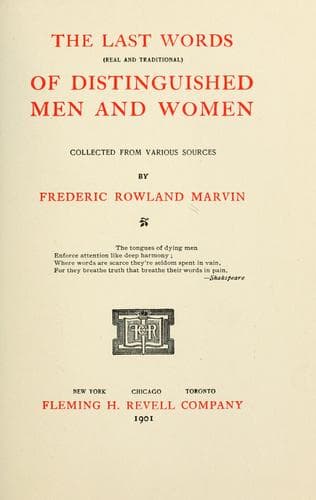
The Last Words (Real and Traditional) of Distinguished Men and WomenMarvin, Frederic Rowland
History
The Last Words (Real and Traditional) of Distinguished Men and Women
Marvin, Frederic Rowland
Last words
[54] Horace lib. iii, Ode 3.
WOLCOTT, or WOLCOT (John, "Peter Pindar," witty and scurrilous satiric
poet. "The most unsparing calumniator of his age."--_Sir Walter Scott_),
1738-1819. "_Give me back my youth_," to Taylor who had asked him "Is
there anything I can do for you?"
Wolcott is well described by Gifford in these lines:
Come, then, all filth, all venom, as thou art,
Rage in thy eye, and rancour in thy heart;
Come with thy boasted arms, spite, malice, lies,
Smut, scandal, execrations, blasphemies.
WOLFE (Charles, Irish clergyman and poet, author of "Burial of Sir John
Moore," which is regarded as one of the most finished poems of its kind
in the English language), 1791-1823. "_Close this eye, the other is
closed already; and now farewell!_"
On going to bed he felt very drowsy; and soon after the stupor of death
began to creep over him. He began to pray for all his dearest friends
individually; but his voice faltering, he could only say--"God bless
them all! The peace of God and of Jesus Christ overshadow them, dwell in
them, reign in them!" "My peace," said he, addressing his sister (the
peace I now feel), "Be with you!"--"Thou, O God, wilt keep him in
perfect peace whose mind is stayed on Thee." His speech again began to
fail, and he fell into a slumber; but whenever his senses were recalled
he returned to prayer. He repeated part of the Lord's prayer, but was
unable to proceed; and at last, with a composure scarcely credible at
such a moment, he whispered to the dear relative who hung over his
death-bed, "Close this eye, the other is closed already; and now
farewell!" Then, having again uttered part of the Lord's prayer, he fell
asleep.
_Rev. John A. Russell: "Remains of Rev. Charles Wolfe."_
WOLFE (James, a celebrated English officer, killed in the battle of
Quebec), 1726-1759. "_I die happy._" On being told of the defeat of the
French.
Some give his last words thus: "Support me, let not my brave soldiers
see me drop; the day is ours! Oh! keep it!" Said to those who were near
him when he received his wound. He feared the effect of his death upon
his troops.
WOLLSTONECRAFT (Mary, afterwards Mrs. Godwin, English authoress),
1759-1797. "_I know what you are thinking of, but I have nothing to
communicate on the subject of religion_," to her husband who was
endeavoring to tell her death was near and to sound her mind in the
matter of a spiritual world.
WOLSEY (Thomas, known in history as Cardinal Wolsey), 1471-1530.
"_Master Kingston, farewell! My time draweth on fast. Forget not what I
have said and charged you withal; for when I am dead ye shall,
peradventure, understand my words better._"
_D'Aubigne's "History of the Reformation."_
Public-domain text, read in full here on John Shaqi.
Reviews
Reviews
No reviews yet
Be the first to share your thoughts on this work.
Elsewhere in the archive
Join the Discussion
Join the discussion
Sign in to leave a comment or review.
Sign InorCreate an account