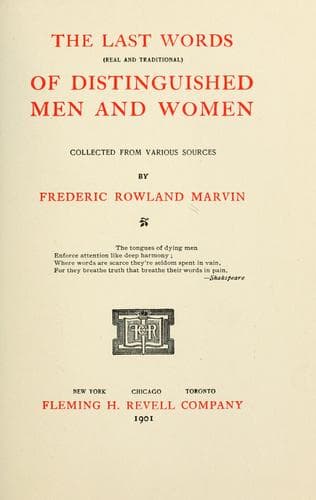
The Last Words (Real and Traditional) of Distinguished Men and WomenMarvin, Frederic Rowland
History
The Last Words (Real and Traditional) of Distinguished Men and Women
Marvin, Frederic Rowland
Last words
[56] William Wordsworth died April 23rd, 1850, at the age of 80, and
was buried in the little centry-garth of St. Oswald's, Grasmere,
between, as De Quincey records, "a yew-tree of his own planting, and
an aged thorn." On his tombstone is an inscription from the pen of
Keble, in which he is styled, "a chief minister, not only of noblest
poesy, but of high and Sacred truth." Surely the tender lover of
Nature, and high-priest of her mysteries, could have no fitter
resting-place than this Westmoreland churchyard, where, as some one
has written, "the turf is washed green by summer dew, and winter
rain, and in early spring is beautifully dappled with lichens and
golden moss?" This reads very prettily, and represents the thing as
it should be. But what are the facts? The literary pilgrim who may
chance to visit the spot will follow a narrow muddy path among the
grave mounds, till he reaches a gloomy dingy corner, with a group of
blue-black head-stones of funereal slate. Everything round the place
is decayed and blighted; no green grass is there; all is dull, dark
and depressing. The poet's corner is ill-drained; and there is a
tiny moat of water round the base of the stone curb, in which is
fixed the iron railing that surrounds the grave. Yet here is a
remarkable group of memorial tombs. Near to the poet lie all the
beloved members of his household. Here slumbers his favorite sister,
Dorothy; here, too, Mrs. Wordsworth,--Dora Wordsworth,--her husband,
Edward Quillinan, the poet, and translator of the _Lusiad_,--the two
infant children of Wordsworth,--and behind these, Hartley Coleridge,
that "inheritor of unfulfilled renown," whose bier the poet followed
one snowy day in January, unwitting that, before the trees were
again clad with verdure, he would be borne along the same narrow
path to his own long rest. Surely something should be done to rescue
the poet's monument from decay, and render it more in accordance
with the verdant foliage and the sun-bright hills around, of which
he sung so lovingly and so well.
_William Bates._
WOTTON (Sir Henry, English diplomatist, author of some very beautiful
short poems and of a number of books, chief among which are "The State
of Christendom," and "The Characters of Some of the English Kings"),
1568-1639. "_I now draw near to the harbor of death--that harbor that
will rescue me from all the future storms and waves of this restless
world. I praise God, I am willing to leave it, and expect a better--that
world wherein dwelleth righteousness, and I long for it._"
Public-domain text, read in full here on John Shaqi.
Reviews
Reviews
No reviews yet
Be the first to share your thoughts on this work.
Elsewhere in the archive
Join the Discussion
Join the discussion
Sign in to leave a comment or review.
Sign InorCreate an account