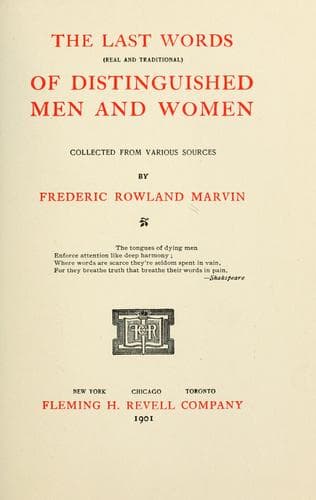
The Last Words (Real and Traditional) of Distinguished Men and WomenMarvin, Frederic Rowland
History
The Last Words (Real and Traditional) of Distinguished Men and Women
Marvin, Frederic Rowland
Last words
WYATT (Sir Thomas, the younger), 1520-1554. On the scaffold he said to
the people: "Whereas it is said abroad that I should accuse my Lady
Elizabeth's grace and my Lord Courtenay; it is not so, good people, for
I assure you that neither they nor any other now yonder in bold
endurance was privy of my rising a commotion before I began." Weston,
his confessor, shouted, "Believe him not, good people! he confessed
otherwise before the council." Wyatt answered: "_That which I said then
I said, but that which I say now is true._" These were Wyatt's last
words.
WYCHERLEY (William, author of "The Plain-dealer," "The Country Wife,"
and several other comedies), 1640-1715. "_Promise me you will never
again marry an old man_," said to his wife.
When he was over seventy years old he married a young woman, but he
survived his marriage only eleven days.
XIMENES DE CISNEROS (Francisco, Spanish cardinal), 1719-1774. "_This is
death._"
YANCEY (William Lowndes, American politician, secessionist and
commissioner to Europe to secure recognition of the Southern
Confederacy. He was called "The Fire-Eater"), 1815-1863. "_Sarah_," his
wife's name.
YVART (J. A. Victor, called "The Arthur Young of France"), 1764-1831.
"_Nature, how lovely thou art!_"
ZANE (Giacomo, a Venetian poet), 1529-1560. "_I should like to live._"
There is dispute about these words; some writers say his last words
were: "I should _not_ like to live."
ZEISBERGER (David, German missionary among the American Indians, author
of a number of books in the language of the Delaware Indians),
1721-1808. "_I am going, my people, to rest from all my labors and to be
at home with the Lord. He has never forsaken me in distress, and will
not forsake me now. I have reviewed my whole life, and found that there
is much to be forgiven._"
ZENO, or ZENON (Greek philosopher and founder of the school of the
Stoics), about B. C. 355--about B. C. 257. "_Earth, dost thou demand me?
I am ready._" Last recorded words.
The occasion of the philosopher's death is related as follows: "One day,
as he was coming out of his school, he ran against some object and broke
his finger; this he considered as an intimation from the gods that he
must soon die; and, immediately striking the ground with his hand, he
said, 'Earth, dost thou demand me? I am ready.' Instead of seeking to
have his finger healed, he deliberately strangled himself.
"He had taught publicly forty-eight years without intermission; and,
reckoning from the time when he commenced his studies under Crates, the
Cynic, he had devoted himself to philosophy for sixty-eight
years."--_Fenelon._
ZIMMERMANN (Johann Georg von, eminent Swiss physician of the eighteenth
century, and author of a famous essay on "Solitude"), 1728-1795. "_I am
dying; leave me alone._"
He was completely deranged for some time before his death.
Public-domain text, read in full here on John Shaqi.
Reviews
Reviews
No reviews yet
Be the first to share your thoughts on this work.
Elsewhere in the archive
Join the Discussion
Join the discussion
Sign in to leave a comment or review.
Sign InorCreate an account