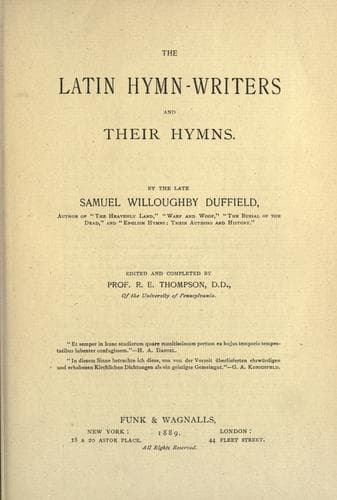
The Latin Hymn-writers and Their HymnsDuffield, Samuel Willoughby
Religion
The Latin Hymn-writers and Their Hymns
Duffield, Samuel Willoughby
Hymns, Latin -- History and criticism
Its date is thus, to some extent, fixed for us. We cannot refer it to
the days of Ambrose, and, since it is found in nearly all the twelfth to
fourteenth-century breviaries, we are unable to attribute it to the
period of the Renaissance. Its very verse would prevent this, if nothing
else did. The word _spiritalis_ is a barbarism—an altogether
post-classical expression. The true usage is that in which the genitive
case is employed, thus “spiritual delight” would be _animi felicitas_,
not _spiritalis_ (or _spiritualis_) _felicitas_. _Perpetim_ is also a
word which purists of the new classic revival would avoid if they could.
So, too, there is a certain amount of stress to be put upon the scanning
of _Paraclitus_—where the _i_ is long, though Prudentius in the fifth
century and Adam of St. Victor in the twelfth both make it short. It has
therefore been said that the hymn was composed by a person who was
skilled in the Greek language. This altogether depends on the question
whether he pronounced the word by accent or by quantity. But still it is
not to be denied that the prosody of the poet gives us reason to think
that he did pronounce the word with the accent on the η. If this be so,
it would follow that he was a man of rare and fine scholarship in
comparison with the contemporaneous learning.
Another criticism is purely theological and aids in fixing the date by
the history of doctrine itself. At the Council of Toledo A.D. 589, the
word _filioque_ was added to the Creed to indicate the faith of the
Church in the procession of the Holy Spirit from both the Father and the
Son. This hymn preserves this point of the orthodox belief with such
care that there can be no doubt of its being subsequent in time to the
date of that council.
In coming more particularly to the various authors who have been
credited with its composition, it may be well to attend to each claim as
it is put forward in some sort of chronologic order.
George Fabricius of Chemnitz (1564) was ready enough to ascribe it to
Ambrose himself. The only ground for this conjecture is the structure of
the verse. And this is no more a proof of authorship than that a hymn
written in what we call “long metre” must be, because of that fact
alone, the production of Isaac Watts. On the other hand, it is plain
that the theological allusion and the doxology, when taken together,
remove the hymn far enough away from the days of the great Bishop of
Milan.
Public-domain text, read in full here on John Shaqi.
Reviews
Reviews
No reviews yet
Be the first to share your thoughts on this work.
Elsewhere in the archive
Join the Discussion
Join the discussion
Sign in to leave a comment or review.
Sign InorCreate an account