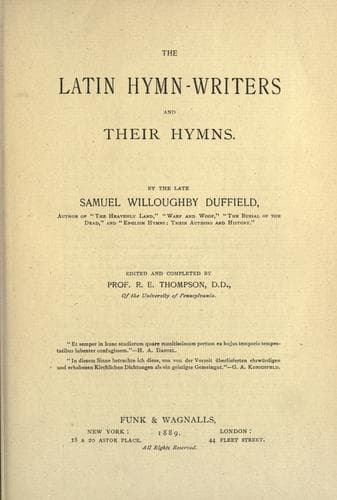
The Latin Hymn-writers and Their HymnsDuffield, Samuel Willoughby
Religion
The Latin Hymn-writers and Their Hymns
Duffield, Samuel Willoughby
Hymns, Latin -- History and criticism
The notable thing about all Bede’s hymns is the influence which the old
forms of Teutonic poetry—the alliterative staff-rhyme—have exerted on
their construction. We can even trace an approximation to alliteration
in his verses, while rhyme is rather an accident than an object. The
verses of Beowulf and of Caedmon were in his mind when he wrote. That he
could use the classic metres also, we see from his poem in hexameters on
the life of Cuthbert of Lindisfarne, the great Scoto-Irish saint, whose
deeds still filled the North with their echoes.
CHAPTER XII.
RABANUS MAURUS, AUTHOR OF THE “VENI, CREATOR.”
None of the great Latin hymns is more regarded than the _Veni, Creator
Spiritus_. The _Dies Irae_ may be grander; the _Veni, Sancte Spiritus_
may be sweeter; the _Ad perennis vitae fontem_ may be lovelier; the
_Stabat mater_ may be more pathetic, but, after all, the _Veni, Creator_
holds a place of equal honor in the estimation of the Church. The Church
of England, while rejecting every other Latin hymn from her services,
nevertheless retained this in the offices for the ordering of priests
and consecration of bishops. This is only the carrying out, indeed, of
the account given by the famous but unknown monk of Salzburg who
rendered so many of the Latin hymns into the old High-German tongue. He
says, “Whoever repeats this hymn by day or by night, him shall no enemy
visible or invisible assail.” This has always been the repute of the
hymn, and there is no doubt that this attended it on its journey down
the ages in the worship of the Church.
Its authorship, however, has been less carefully preserved than its
text, which is notably free from mutilation and obscurity. It is really
singular to find a hymn which has been so universally employed, and
which has escaped in such a marvellous manner from the profane meddling
of prosaic or bigoted revisers. Its doxologic final stanza is one which
is not often to be found elsewhere—as though the hymn had taken and
maintained a place apart. If it were the product of the Ambrosian age
this would not be likely to have occurred, for all those doxologies are
formal and interchangeable to a marked degree. But this is the
appropriate conclusion of a unique ascription of praise to the third
person of the Trinity.
Public-domain text, read in full here on John Shaqi.
Reviews
Reviews
No reviews yet
Be the first to share your thoughts on this work.
Elsewhere in the archive
Join the Discussion
Join the discussion
Sign in to leave a comment or review.
Sign InorCreate an account