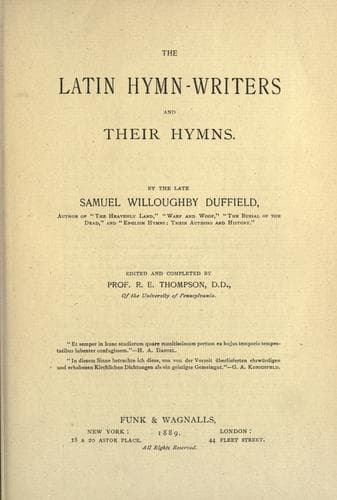
The Latin Hymn-writers and Their HymnsDuffield, Samuel Willoughby
Religion
The Latin Hymn-writers and Their Hymns
Duffield, Samuel Willoughby
Hymns, Latin -- History and criticism
There was a certain Christopher Brower, a Jesuit and a profoundly
learned scholar, who was born in 1559 at Arnhem in Gelderland. In the
year 1580 he went to Cologne in pursuit of his studies. Then he studied
philosophy at Trier, and eventually became rector of the college at
Fulda. Here he wrote four books upon antiquarian topics. His diligent,
exhaustive style can be judged by the fact that he spent thirty years
upon a history of Trier. His _Antiquitates_ were printed in 1612, but in
1603 he had edited the writings of Fortunatus, and this book was
reissued in 1617, the year of his death, by Joannes Volmar at Cologne.
This edition has an appendix of 150 pp. 4to., in which is contained the
entire series of hymns and other poetical compositions which were due to
the aforesaid Bishop of Mainz, Rabanus Maurus. It was edited from a very
old MS. of undoubted veracity, and it contains the _Veni, Creator_ in
the precise text which we now employ. It is to be noticed that it does
not recognize the doxology _Sit laus_, etc., and this Mone assures us
was composed at a later period by Hincmar of Rheims, and is, as we have
said, unique. But it accents Paraclitus upon the second _a_ and not upon
the _i_.
The stanza _Da gaudiorum_, etc., was rejected some time ago by the best
scholars. It is from a hymn of later date. And we therefore find the
version which appears in Brewer’s editions of the poems of Rabanus
Maurus to be consonant with the most intelligent criticism of the text
of the _Veni, Creator_.
The hymn itself we can assign with very considerable certainty to the
author in whose pages it again is apparent, and we may believe in the
accuracy and scholarly acuteness of the Jesuit antiquarian.
It will not be amiss if we set our reasons in order, for a
long-established delusion is as hard to overthrow sometimes as the
stubbornest fact. They are such as the following:
1. The hymn is found in the writings of Rabanus Maurus, in a codex which
Brower calls “very ancient and well approved.”
Public-domain text, read in full here on John Shaqi.
Reviews
Reviews
No reviews yet
Be the first to share your thoughts on this work.
Elsewhere in the archive
Join the Discussion
Join the discussion
Sign in to leave a comment or review.
Sign InorCreate an account