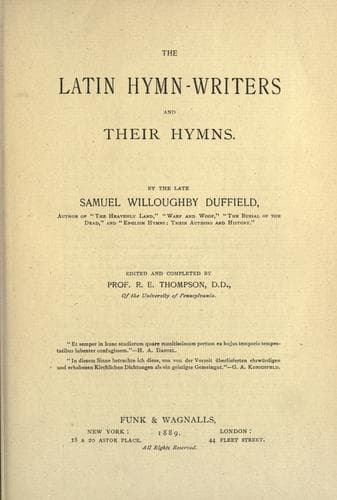
The Latin Hymn-writers and Their HymnsDuffield, Samuel Willoughby
Religion
The Latin Hymn-writers and Their Hymns
Duffield, Samuel Willoughby
Hymns, Latin -- History and criticism
2. It is the precise paraphrase of the learned bishop’s chapter on the
Holy Spirit. Thus he begins the chapter with an assertion of the
procession of the Holy Spirit from both the Father and the Son. He then
calls this Spirit _donum Dei_, and several times repeats the phrase. He
argues that the Spirit is coequal and coeternal God. He then discusses
the term _Paraclete_, and proceeds to speak of the _septiformis_ nature
of His power. Next follows a most significant and unusual
expression—namely, that the Holy Spirit is _digitus Dei_—the finger of
God. And the consecution and coincidence of thought is still further
increased by an allusion to the grace which bestowed the gift of
tongues. He then speaks of the Spirit as fire—which accords with the
word _accende_—and then he explains the simile of water, which
corresponds with the word _infunde_ and with the previous phrase _fons
vivus_. He also quotes from the Gospel of John to show that this “living
water” means no more nor less than the Holy Spirit. These coincidences
are doubly remarkable, for they not only exhibit the same ideas—some of
which, by the way, are quite uncommon—but they also set them forth in
the precise order in which the good bishop employs them in his hymn. It
is as if, being aroused and animated by his great and noble theme, he
had turned to verse as an appropriate medium of lofty praise and had
sung from his heart this immortal hymn.
3. To these reasons we may add a third—that the internal structure of
the hymn shows its author to have been a person of theological
soundness, spiritual insight, scriptural knowledge, genuine scholarship,
and a natural poetical capacity. These facts again agree with what we
know to have been the talents and learning of Rabanus Maurus.
4. If Gregory had written this hymn it would have appeared at an earlier
date and would have been undoubtedly attributed to its illustrious
author; whereas it is not in his carefully compiled writings nor is it
accredited to him by Thomasius or any hymnologist before the time of
Mone and Wackernagel.
5. Charles the Great had not the learning, and both he and his grandson,
Charles “the Bald,” are named on the strength of a long-exploded and
always anachronistic tradition.
6. Ambrose is out of the question by the theological limitation of the
stanza _Per te sciamus_, etc.
7. Finally, we have the right to believe that a man whose other hymns
have been so extensively, though anonymously, introduced into the
worship of the Church, was entirely competent to frame this present
hymn.
Public-domain text, read in full here on John Shaqi.
Reviews
Reviews
No reviews yet
Be the first to share your thoughts on this work.
Elsewhere in the archive
Join the Discussion
Join the discussion
Sign in to leave a comment or review.
Sign InorCreate an account