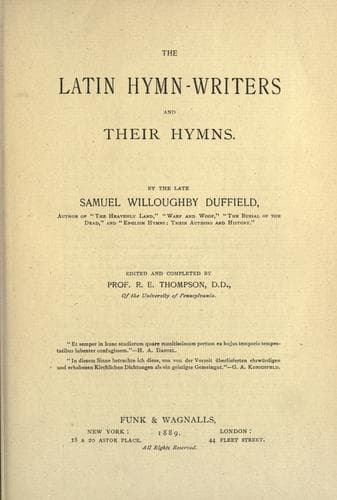
The Latin Hymn-writers and Their HymnsDuffield, Samuel Willoughby
Religion
The Latin Hymn-writers and Their Hymns
Duffield, Samuel Willoughby
Hymns, Latin -- History and criticism
Qui Paraclitus diceris,
Donum Dei altissimi,
Fons vivus, ignis, charitas,
Et spiritalis unctio.
Tu septiformis munere,
Dextrae Dei tu digitus,
Tu rite promissum Patris,
Sermone ditans guttura.
Accende lumen sensibus,
Infunde amorem cordibus,
Infirma nostri corporis,
Virtute firmans perpetim.
Hostem repellas longius,
Pacemque dones protinus,
Ductore sic te praevio
Vitemus omne noxium.
Per te sciamus da Patrem
Noscamus atque Filium,
Te utriusque Spiritum,
Credamus omni tempore.
O Holy Ghost, Creator, come!
Thy people’s minds pervade;
And fill with thy supernal grace
The souls which thou hast made.
Thou who art called the Paraclete,
The gift of God most high;
Thou living fount, and fire, and love,
Our spirit’s pure ally;
Thou sevenfold Giver of all good;
Finger of God’s right hand;
Thou promise of the Father, rich
In words for every land;
Kindle our senses to a flame,
And fill our hearts with love,
And through our bodies’ weakness, still
Pour valor from above!
Drive farther off our enemy,
And straightway give us peace;
That, with thyself as such a guide,
We may from evil cease.
Through thee may we the Father know,
And thus confess the Son;
For thee (from both the Holy Ghost),
We praise while time shall run.
Rabanus Maurus, teacher and Abbot of Fulda and Archbishop of Mayence
(Mainz), was commonly called the “foremost German of his time.” Though
the centuries have somewhat obscured the lustre of his renown, they have
not deprived him of his place in history, nor have they dissociated his
name from that of his instructor, prototype, and model, the great
pedagogue Alcuin.
Of the birthplace of Rabanus we have no certain knowledge. Some have
said that he was Scotch or English, others that he was French; but the
more reliable authorities are convinced that he was a German, born
either at Fulda or Mainz. The epitaph written by himself affords
probably the solution of the question. It was composed at Mainz while
its author was archbishop, and contains these words:
“Urbe quidem hac genitus sum, ac sacro fonte renatus,
In Fulda post haec dogma sacrum didici.”
That is, he was born at the place where he was writing these verses—most
likely Mainz—and there he was baptized. Afterward he was educated in
Fulda. An additional reason for this belief is that his father was of a
family known in the records of Mainz.
Public-domain text, read in full here on John Shaqi.
Reviews
Reviews
No reviews yet
Be the first to share your thoughts on this work.
Elsewhere in the archive
Join the Discussion
Join the discussion
Sign in to leave a comment or review.
Sign InorCreate an account