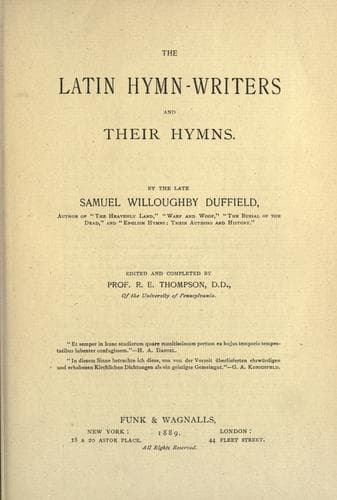
The Latin Hymn-writers and Their HymnsDuffield, Samuel Willoughby
Religion
The Latin Hymn-writers and Their Hymns
Duffield, Samuel Willoughby
Hymns, Latin -- History and criticism
Trithemius says that Rabanus was born in 788 _quarto nonas Februarii_,
the second of February. Mabillon adds, “I do not know whence he got the
day; the year is probably pretty close.” But the year itself, on the
strength of internal evidence found in the man’s writings and in the
monastic rules regarding the holding of office before the attainment of
a fixed age, Mabillon places at 776. This extension of twelve years is a
very important affair since it makes Rabanus a monk of thirty-three at
the date of the Council of Aquisgranum (Aix-la-Chapelle or Aachen),
called by Charlemagne to reannunciate the doctrine of the procession of
the Holy Spirit.
The name of Rabanus’s father was Ruthard and his mother was christened
Aldegunde. “She was a woman of the most honest conversation,” as
Trithemius declares, the fit helpmeet of a man “rich and powerful, who
for a long time served in the wars under the Frank princes.” There was a
brother, doubtless an elder brother, called Tutin, a person “noble among
the first,” and perhaps the father of a nephew, Gundram, whom Rabanus
mentions as the royal chaplain of Lewis of Germany.
The lad Raban—“the raven”—took on his dark garments at nine years of age
and went to be a little shaveling monk at Fulda. There he continued,
patiently toiling on at his studies according to the methods of a
benighted time, and it is plain that he progressed so well as to get the
favor of his abbot, Ratgar. Since Ratgar took office in 801 or 802, and
Alcuin died in May, 804, it must have been at or about the twenty-fifth
year of his age that Rabanus was directed to put himself under the care
of Alcuin. A record which has been preserved shows that in 801 our poet
had been made a deacon at Fulda, and it is natural for us to look upon
this journey to the monastic school of St. Martin at Tours as an honor
given to one who had already earned some distinction in scholarship.
Be this as it may it is certain that nearly the latest work of Alcuin’s
life was the preparation of the successor to his own ideas who should
hold high the torch of knowledge to his land and generation. To
him—though the old eyes at Tours should not see it—was to succeed
Walafrid Strabo, and to Walafrid Strabo were to be added the scholars of
St. Gall, and notably the marvellous cripple Herman of Reichenau. Ratgar
now was busy building a great church, and architectural notions befogged
his brain. But he had built better than he was aware when he sent off
Rabanus and Hatto to sit at the feet of the man who had brought the
system of Bede the Venerable into Gaul, and who was to commit his own
enthusiasm for learning to a greater scholar than Paul Winfrid, the
Deacon.
Public-domain text, read in full here on John Shaqi.
Reviews
Reviews
No reviews yet
Be the first to share your thoughts on this work.
Elsewhere in the archive
Join the Discussion
Join the discussion
Sign in to leave a comment or review.
Sign InorCreate an account