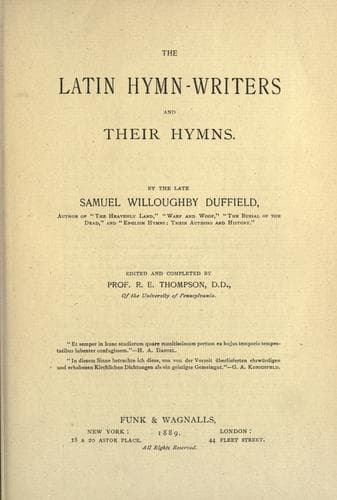
The Latin Hymn-writers and Their HymnsDuffield, Samuel Willoughby
Religion
The Latin Hymn-writers and Their Hymns
Duffield, Samuel Willoughby
Hymns, Latin -- History and criticism
Such was the character of church music when the song school of St. Gall
was started. The monks had already been so fortunate as to secure one of
the two Gregorian antiphonaries sent by Pope Adrian to the Emperor
Charles the Great. The occurrence was curious enough to be chronicled,
and the story merits our own repetition. Metz had been the German music
centre, but when the French music clashed with that which was considered
the correct and Gregorian method, Charles again solicited from the Pope
two priests who were thorough musicians, and should put Metz and her
school above criticism. These two men, by name Peter and Romanus, set
out thereupon, but took a heavy cold between them at Lago Maggiore
(_aere Romanis contrario quaterentur_). Peter soon recovered, but
Romanus advanced from a mere cold into an actual fever, and remained at
St. Gall with one of the antiphonaries, while the disgusted Peter, who
claimed both copies, was forced to proceed alone and with a single
manuscript to Metz.
St. Gall was sufficiently attractive to Romanus for him to make no
effort to leave it when he grew convalescent. And these compositions and
melodies of his were the foundation upon which, in later years, Notker
and Hartmann and the others built their sequences. That which Maengal
now effected was the real beginning of that system of music which is so
elaborately treated by Dr. Neale in his preface to the second volume of
Daniel’s _Thesaurus_. Perhaps more has been made of it there than it
really deserves. It is certainly too far out of the line of this inquiry
of ours for us to discuss the point technically. One of the best
definitions of the sequence is, however, that of Mabillon, who calls
such compositions “rhythmical prayers” (_rythmicae preces_).
Notker became easily—so Ekkehard asserts—the finest musician about the
abbey. He was also a bright and rather witty man. When Augustine was
asked what God was doing before He created the world, he replied that He
“was building hell for such vain and frivolous spirits” as that of his
questioner. The chaplain of Charles the Fat put a similar inquiry to
Notker, and got quite as brief a retort. He asked, “What is God doing
now?” And Notker stammered out, “Just what He has always done and always
will do; He is putting down the proud and exalting the humble!”
Public-domain text, read in full here on John Shaqi.
Reviews
Reviews
No reviews yet
Be the first to share your thoughts on this work.
Elsewhere in the archive
Join the Discussion
Join the discussion
Sign in to leave a comment or review.
Sign InorCreate an account