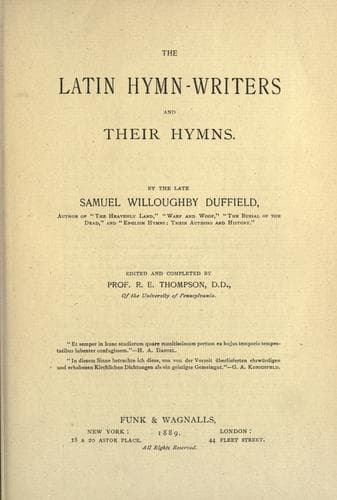
The Latin Hymn-writers and Their HymnsDuffield, Samuel Willoughby
Religion
The Latin Hymn-writers and Their Hymns
Duffield, Samuel Willoughby
Hymns, Latin -- History and criticism
The Sangallensian poets are not, however, very numerous. Hartmann was
probably the earliest composer of a “sequence”—a style of sacred poem
which we shall consider presently. Then came Notker Balbulus, who has
the greater renown. Tutilo and Ratpert and Walafrid Strabo complete the
list. St. Gall was for years a noted centre of learning. It is well
situated, and from its towers the waters of the Boden-See (from which it
is distant but a few miles) can be readily discerned.
Here, then, Notker began his religious life. He had probably seen the
light in the green and fertile Thurgau not far away from St. Gall. And
his talents were soon so noticeable that he rapidly advanced in the
esteem of his associates. Meanwhile—for the Irish and Scottish monks
made this a thoroughfare on their pilgrimages to Rome—there came along
an Irish bishop named Mark, whose nephew, Maengal, strongly aroused the
admiration of Notker. Maengal’s music especially affected him, and he
devoutly prayed God to let the Irishman tarry with them at St. Gall.
This indeed happened, and Maengal, rechristened Marcellus, remained in
Switzerland.
This good tutor now undertook the musical training of Notker, Ratpert,
and Tutilo. And from this beginning arose the choral school of St. Gall.
Ekkehard’s history of it is most suggestive. It was originally begun, he
says, for the study of the Gregorian tones, but these Swiss people had
by degrees lost the sweetness of the old Pope’s music. And he borrows
the language of John the Deacon, in his life of Gregory, to satirize the
“thundering voices” with which such “Alpine bodies” failed to secure the
proper modulation. I borrow Baring-Gould’s idiomatic rendering of this
significant passage. It runs as follows:
“The barbarous hugeness of those tippling throats, when endeavoring to
utter a soft song full of inflections and diphthongs, makes a great
roar, as though carts were tumbling down steps headlong; and so, instead
of soothing the minds of those who listen, it agitates and exasperates
them beyond endurance.”
Public-domain text, read in full here on John Shaqi.
Reviews
Reviews
No reviews yet
Be the first to share your thoughts on this work.
Elsewhere in the archive
Join the Discussion
Join the discussion
Sign in to leave a comment or review.
Sign InorCreate an account