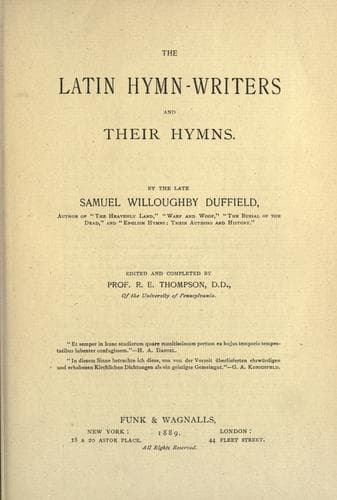
The Latin Hymn-writers and Their HymnsDuffield, Samuel Willoughby
Religion
The Latin Hymn-writers and Their Hymns
Duffield, Samuel Willoughby
Hymns, Latin -- History and criticism
But St. Gall itself had always prospered, apparently as the sun does
according to the theories of some astronomers, for it had been
continually receiving cometary accessions that dropped into it
unexpectedly. One such was an antiphonary, which, on the principle that
“to him that hath shall be given,” fell into the hands of these musical
monks through the burning of the Abbey of Jumieges in 851. This was the
true origin of the “sequence.” It solved the problem of Notker in a
novel manner when he finally examined it, for he had been puzzled at the
immense prolongation of the final syllable _ia_ in the _Alleluia_, which
was sung to cover the retreat of the deacon as he ascended to the
rood-loft to chant the Gospel. This _Alleluia_ came between the Epistle
and the Gospel, and as the deacon had some space to traverse, the _ia_
was nearly interminable; for even a very few seconds became on such an
occasion a most perceptible and wearisome interval of time.
This Jumieges antiphonary, in which words were fitted to the Gregorian
tones, suggested another treatment of the difficulty. Notker
consequently composed the _Laudes Deo concinat_, and afterward the
_Coluber Adae male suasor_. Iso, his master, approved of them, and
Maengal afterward gave him considerable help. The “sequence” in its
standard form had a “note to each syllable,” as in modern church music.
And this was the beginning of that Book of Sequences perfected by him in
887, and which has gained a merited prominence for the name of Notker
Balbulus.
Ekkehard tells certain legends (which may or may not be trustworthy)
regarding the suggestion whence some of these sprung. The droning
rotation of a slow mill-wheel gave rise, he says, to the sequence
_Sancti Spiritus adsit nobis gratia_; and this is far more credible than
the additional information that Notker sent it to “the Emperor” Charles
and got back the famous _Veni Creator Spiritus_—a story which Mabillon
utterly confutes. This Emperor was certainly _not_ Charles the Great—who
was long ago dead—and it _might_ have been Charles “the Bald” or Charles
“the Fat” (the usurper), or Charles “the Simple,” but there seems an
antecedent improbability that any such nickname could belong to the
grave and great poet of that splendid hymn. And, indeed, we are now
positive that it is the composition of Rabanus Maurus, Bishop of Mayence
(Mainz), who died in 856.
Public-domain text, read in full here on John Shaqi.
Reviews
Reviews
No reviews yet
Be the first to share your thoughts on this work.
Elsewhere in the archive
Join the Discussion
Join the discussion
Sign in to leave a comment or review.
Sign InorCreate an account