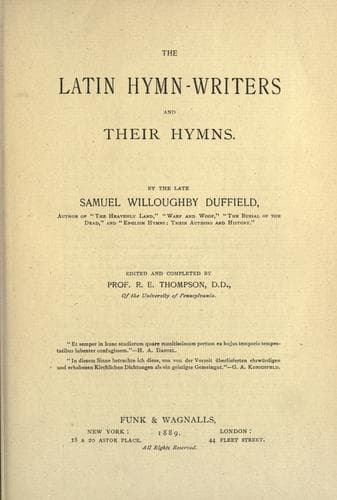
The Latin Hymn-writers and Their HymnsDuffield, Samuel Willoughby
Religion
The Latin Hymn-writers and Their Hymns
Duffield, Samuel Willoughby
Hymns, Latin -- History and criticism
There is probably some show of reason in the idea that the groaning
machinery of a mill should have helped to originate the extended notes
of the sequence. The picturesqueness of the story is really its best
claim to our notice. I well remember a mill by which I used often to
pause in the stillness of night, listening to the wailing protracted
cadences of the huge wheel which slowly turned in its bed as the buckets
successively filled from the shut, but leaky gates. Hearing this, and
comparing it with the “sequence” of the Catholic service, or with the
long-drawn tones of a German choral, it is impossible not to be struck
by the resemblance.
Then there is another story—indeed, there are several in the Latin which
could scarcely be inserted here—but there is certainly one other which
both Baring-Gould and Maitland have had sufficient geniality to extract.
It refers to the manner in which Notker, Ratpert, and Tutilo—“the three
inseparables”—attended to the eavesdropping of one of Abbot Salomon’s
spies. This spy was Sindolf, the _refectorarius_, or steward, a
sour-visaged, crab-appleish kind of man, who was never so happy as when
he had an evil speech to retail. He particularly delighted in fretting
the temper of the abbot with reference to these poets and musicians, but
they suspected his design and “set a watch because of him.”
One evening after “lauds” the three were in the “writing-room”
(_scriptorium_) where the manuscripts were prepared and kept, busy with
their conversation and having thereto the permission of the prior.
Sindolf sniffed scandal in the air, and flattened his ear against the
opaque glass, where a convenient crack suffered him to listen to their
words. It was night, and Tutilo, a shrewd, lively fellow (_homo
pervicax_), was glad enough to get this occasion against the slinking
traitor. In the _Acta Sanctorum_, and again in Mabillon, copied into the
one hundred and thirty-first volume of Migne, we have old Ekkehard’s
grim report of this monkish fun.
Public-domain text, read in full here on John Shaqi.
Reviews
Reviews
No reviews yet
Be the first to share your thoughts on this work.
Elsewhere in the archive
Join the Discussion
Join the discussion
Sign in to leave a comment or review.
Sign InorCreate an account