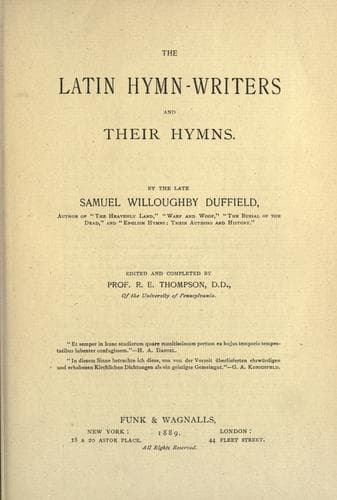
The Latin Hymn-writers and Their HymnsDuffield, Samuel Willoughby
Religion
The Latin Hymn-writers and Their Hymns
Duffield, Samuel Willoughby
Hymns, Latin -- History and criticism
Tutilo was a capital companion; genial and ingenious; capable of music
on all sorts of pipes and fiddles; who told a good story and made many a
good joke; active and agile in his figure, and withal a fine carver,
painter, and goldsmith. Some of his ivory carving still exists in the
town library of St. Gall—so one historian records in a foot-note—and he
was evidently a most skilful musician, whose hymn tunes, composed on the
_rota_, or small harp (the minstrel’s instrument in those days), were
always acceptable. He wrote _Hodie cantandus_, _Omnium virtutum gemmis_,
and _Viri Galilaei_. This last he sent to “King Charles,” who himself
composed a tune to which Tutilo set words called _Quoniam Dominus_. His
royal patron liked him well. “Curse the man,” he said one day, “he is
altogether too good a fellow to be a monk!” Ekkehard adds to this list
of compositions the sequence _Gaudete et cantate_ as a specimen of
Tutilo’s ability in a slightly different direction of music, declaring
that “any one who understands music” will notice and appreciate the
distinction.
Hartmann was abbot after Salomon; a most learned man, and one who
perhaps contributed more to the development of the “sequence” than we
are now able to prove.
Of Notker it is only fair to say that he gave to himself the name
_Balbus_, or Stammerer, which was changed, owing apparently to his small
stature, into the diminutive, _Balbulus_. When Innocent III. asked
Uadalric, then Abbot of St. Gall, what rank Notker had held in the
convent, the abbot replied that he was only “a simple monk,” but was
born of noble parents and was thoroughly holy and well educated. On
which the Pope declared that they were wretched and wicked people
(_nequissimi_), and would suffer for it (_infelices eritis_) if they did
not celebrate the festival of this man who had been “so full of the Holy
Spirit.” Julius II. commanded Hugo, Bishop of Constance, to inquire into
the matter. The result established him as a beatified confessor, and so
distinguished him by the prefix “Blessed” from Notker “the Abbot,” who
was his nephew, and died 973; Notker “the Physician,” who died 1033;
Notker “of Liege,” who died 1007, and Notker “Labeo,” who died 1022. B.
Notker Balbulus himself died in 912. Salomon, who was then his abbot,
died in 919, and in 921 Hartmann succeeded to the dignity.
It would not be difficult to add to this account several superstitious
stories; how Notker broke his staff over a dog-devil which went howling
through the church; how he had some difficulty with another demon who
intermeddled with pen and ink; how he severely handled a flagitious
monk; and, generally, how he proved to be a moderate worker of miracles
and a pleasant colleague to the other cenobites.
But we turn with a peculiar interest to that little sequence which has
made his name immortal. This _Media vita in morte sumus_ is the one
which meets us in the Burial Service of the Protestant Episcopal Church:
Public-domain text, read in full here on John Shaqi.
Reviews
Reviews
No reviews yet
Be the first to share your thoughts on this work.
Elsewhere in the archive
Join the Discussion
Join the discussion
Sign in to leave a comment or review.
Sign InorCreate an account