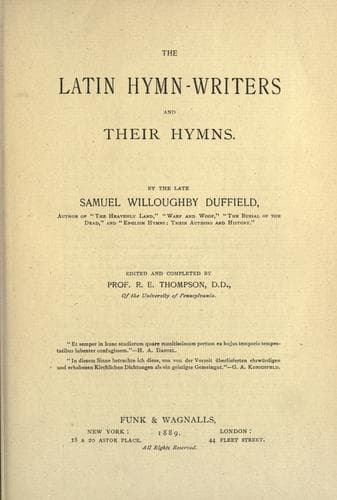
The Latin Hymn-writers and Their HymnsDuffield, Samuel Willoughby
Religion
The Latin Hymn-writers and Their Hymns
Duffield, Samuel Willoughby
Hymns, Latin -- History and criticism
“In the midst of life we are in death:
Of whom may we seek for succor
But of thee, O Lord,
Who for our sins art justly displeased?”
It is there found in connection with a passage from the Book of Job, and
is followed by the _Sancte Deus; Sancte fortis; Sancte et misericors
Salvator, Amarae morti ne tradas nos_; which is in our translation,
“Yet, O Lord most holy, O Lord most mighty, O holy and most merciful
Saviour, deliver us not into the bitter pains of eternal death.” All
that Notker originally composed is that which is first mentioned above.
The rest came about as we shall presently see.
The Rev. F. Proctor, in his _History of the Book of Common Prayer_,
states that this brief sequence—of which he does not appear to know the
origin—“was formed from an antiphon which was sung at Compline during a
part of Lent.” There is also a singular misapprehension by which the
“samphire gatherers” hanging over the cliffs of England at their
“dreadful trade” were credited with the suggestion. It was formerly
supposed that Notker watched them during their dangerous toil, and so,
by another equally strange inadvertence, the fact was taken as a proof
that he must have been himself a native or resident of Britain. This,
like the other legend of the twenty-year debate upon sequences, proves
on inquiry to have no foundation in fact. The story itself is a
sufficient explanation without any coloring whatever. It reveals to us
the poetic spirit of the devout man who beheld his fellow-creatures
poised between life and death, and wrote this short and exquisite
meditation thereon.
“The holy Notker,” says Canisius, “made the ‘prose’ of the following
lament when the bridge [over the chasm] at Martinstobel was being
constructed in a precipitous and most dangerous place. But who added the
‘verses’ I do not know. I have quoted it from a most ancient codex,
where it is set to modern notes.” He then proceeds to give it in the
ordinary form. It is, as he says, a _prose_, and must be distinguished
from _verses_ of regular metre:
“Media vita in morte sumus, quem quaerimus adjutorem, nisi te, Domine,
qui pro peccatis nostris juste irasceris.”
Thus far Notker. Then occur the “verses” in three stanzas:
“Ah homo, perpende fragilis,
Mortalis, et instabilis,
Quod vitare non poteris
Mortem, quocunque ieris.
Aufert te, saepissime,
Dum vivis libentissime.
Sancte deus.
“Vae calamitas inediae,
Vermis fremit invidiae,
Dum audit flentem animam
Mortalis esse utinam!
Nec Christi fati gladius,
Transiret, et non alius,
Sancte fortis.
“Heu nil valet nobilitas
Neque sedis sublimitas,
Nil generis potentia,
Nil rerum affluentia,
Plus pura conscientia
Valet mundi scientia.
Sancte et misericors Salvator,
Amarae morti ne tradas nos.”
Public-domain text, read in full here on John Shaqi.
Reviews
Reviews
No reviews yet
Be the first to share your thoughts on this work.
Elsewhere in the archive
Join the Discussion
Join the discussion
Sign in to leave a comment or review.
Sign InorCreate an account