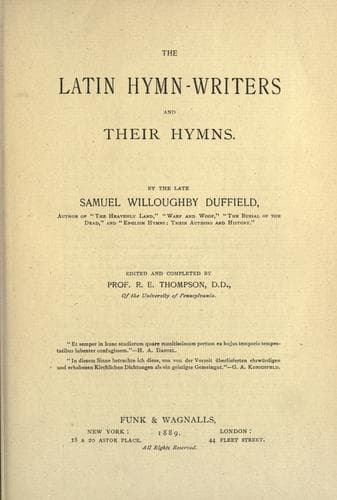
The Latin Hymn-writers and Their HymnsDuffield, Samuel Willoughby
Religion
The Latin Hymn-writers and Their Hymns
Duffield, Samuel Willoughby
Hymns, Latin -- History and criticism
He preserved this calmness and sweetness of temper to the farthest limit
of his days. Not long before he died he said to his faithful friend,
Berthold of Constance, “Do not, I say, do not ask me about this; but
rather attend to what I will tell you, for in you I do not a little
confide. I shall die doubtless in a very short time. I shall not live. I
shall not get well.” He added that he was so “seized with an ineffable
desire and delight toward that intransitory world and that eternal and
immortal life,” that all things of this passing existence seemed empty
and vain and dropped like motes (_flocci_) from him, in the breath of
that heavenly air.
And then he proceeded to detail a vision in which he fancied himself
reading and rereading the Hortensius of Cicero. His mind was clear; his
hopes for religion and for education were high; but all was now over and
he must depart. Therefore he quietly and pathetically ends by saying,
“_Taedet quidem me vivere_”—indeed it is wearisome to me to live. And
thus, on September 24th, 1054, he ceased from earth—in his forty-second
year, and having carried the story of the world down to the end of his
own career.
But his works follow him. I do most firmly believe him—and not Robert
the Second—to have been the author of the _Veni Sancte Spiritus_.
The first person to attribute this hymn to the King of France is Durand,
(_Rationale Divinorum Officiorum_, Lib. IV.) His book treats of
ceremonial observances and is among the rarest of printed volumes. The
splendid copy upon vellum in the Astor Library is not only beautiful in
itself, but it is extremely valuable as the _third_ specimen of
typography in existence. Only two works—one of them the Bible and
another the Psalter of Mainz—had been previously printed from movable
types. I have personally verified the reference and its English
rendering is as follows:
“Notker, Abbot of St. Gall, in Germany, first composed sequences with
notes of his own in the _Alleluia_. And Nicholaus the Pope [Nicholas
II., 1059-1061] granted that they should be sung at masses. But
Hermannus Contractus, a German, inventor of the astrolabe, composed
these sequences: _Rex omnipotens_ and _Sancti Spiritus_ and _Ave
Maria_ and the antiphons _Alma redemptoris mater_ and _Simon Barjona_.
Peter, Bishop of Compostella, made the _Salve regina_. And the King of
France, Robert by name, composed the sequence, _Veni Sancte Spiritus_
and the hymn _Chorus novae Hierusalem_.”
It is hard to crowd into a paragraph more errors than are in this.
Notker was _not_ Abbot of St. Gall. Innocent III. was very severe upon
Udalric of St. Gall, because such a spiritual and able man had lived and
died unhonored among them; a simple monk whose labors and death received
no special attention in their religious year.
Public-domain text, read in full here on John Shaqi.
Reviews
Reviews
No reviews yet
Be the first to share your thoughts on this work.
Elsewhere in the archive
Join the Discussion
Join the discussion
Sign in to leave a comment or review.
Sign InorCreate an account