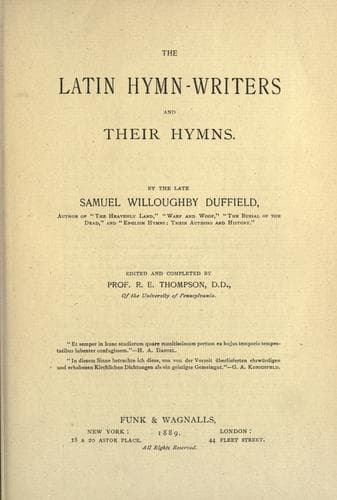
The Latin Hymn-writers and Their HymnsDuffield, Samuel Willoughby
Religion
The Latin Hymn-writers and Their Hymns
Duffield, Samuel Willoughby
Hymns, Latin -- History and criticism
Here he wrote the legends of some of the saints, and here he prepared
his valuable compendium of universal history. He calls it a _Chronicon_,
and condensed into its records the story of the world from A.D. 1 to the
year 1054, the date of his own death. It is very brief through the first
portion of its account of “the Six Ages.” Then its statements are
fuller. When it reaches contemporaneous events it becomes exceedingly
important to the historical student, for it is in the nature of a
chronicle. Here also the man’s own personality occasionally appears. He
speaks of Reichenau as _Augia nostra_ and mentions the basilica which
Henry III. (“the Black”) has erected to “our patron, St. Mark the
Evangelist.” This establishes the fact that Reichenau was his true
residence, and gives us the standpoint of the little isle in Lake from
which to look out across the dark-green and sometimes stormy waters upon
the confusions of the time. These were the days when the Truce of God
(1041 A.D.) was necessary in order to prevent the bloody feuds of the
barons during Advent, Lent, and from Wednesday evening of each week
until the following Monday morning. Yet amid all these conflicts Hermann
the Paralytic remained secure, guarded by religion and surrounded by the
peaceful lake. And like that lake the Rhine stream of secular affairs
flowed always through his life clear and undisturbed.
It is during these closing scenes that a touching entry is made in the
pages of the _Chronicon_. Under the year 1052 the crippled hand slowly
traces these words: “At the same time, on January 9th, my mother
Hiltrude, the wife of the Count Wolfrad, a pious, meek, generous, and
religious woman, and one who was as devoted to and happy in her husband
and her seven surviving children as any person could be, closed the last
day of her life in about the sixty-first year of her age and the
forty-fourth of her marriage, and was buried at the Villa of Altshausen,
in a sepulchre under the chapel of St. Udalric which she had herself
constructed.” And then follows a brief poem in which the merits and the
love of this dear mother are affectionately told.
Hermann, on the best of testimony, was a person of just this amiable and
beautiful spirit. He is called _hilarissimus_, as if to show his great
cheerfulness. He was always a strict vegetarian in his diet. He hated
injustice; scorned every sort of vice—and Heaven alone knows how much
there then was of nameless wickedness!—and finally, he was thoroughly
free from all envy and malice. It is a curious testimony to his breadth
of mind that one of his biographers says of him (quoting the old adage),
that he regarded nothing human as alien to his search.
Public-domain text, read in full here on John Shaqi.
Reviews
Reviews
No reviews yet
Be the first to share your thoughts on this work.
Elsewhere in the archive
Join the Discussion
Join the discussion
Sign in to leave a comment or review.
Sign InorCreate an account