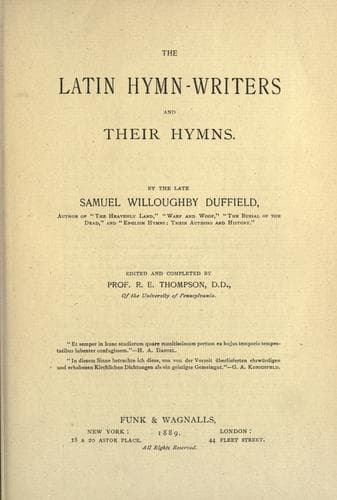
The Latin Hymn-writers and Their HymnsDuffield, Samuel Willoughby
Religion
The Latin Hymn-writers and Their Hymns
Duffield, Samuel Willoughby
Hymns, Latin -- History and criticism
Setting aside Innocent III. for cause—although Brander of St. Gall, in
his _Index Sequentiarum_, grants this to him—the authorship of the hymn
rests between the king and the monk. I say “for cause,” since Innocent
was at the summit of temporal power, and his position was a very
tempting one to posthumous flattery. He is credited with the _Ave mundi
spes Mariae_. He did not write the _Stabat Mater_, nor did he compose
the _Veni Sancte_. Let any one examine the _Ave mundi_ and he will
renounce all hope that the man who prepared this could ever have written
the others, or either of them. Besides, Wrangham is likely to be correct
when he assigns this latter sequence to Adam of St. Victor. It is
precisely in Adam’s style of metrical composition; it is not found
before the fourteenth century, and its tone is modern. It can therefore
be said that Innocent deserves no place among the Latin hymn-writers.
Now, Robert II. is much in the same condition as Innocent III. His is a
shining name to which to affix popular hymns. He has been credited with
the _Ave maris stella_—the parent of all hymns to the Virgin. The
sequence _Sancti Spiritus adsit_ is not his, on the testimony already
adduced; but in the year 1110 the “ancient customs of Cluny,” collected
by St. Udalric (Hermann’s ancestor) gives us this “at Pentecost”
(D’Achery: _Spicilegium_, I., 641), with the “response,” _Spiritus
sanctus_. This would serve to show that such praise to the Holy Spirit
was usual. With the _Chorus Novae_ we have already dealt. And the _Rex
omnipotens_ belongs to Hermann though it is ascribed to Robert—another
instance of inaccuracy, which casts a ray of light upon the present
problem.
Those sequences of which Robert was the possible author are printed in
Migne’s _Patrologia_ (141, 959 _ff._). Only one of them merits a word of
notice. It is the _Te lucis auctor personent_. Daniel assigns this to
the fourteenth or fifteenth century, but Mone and Koch to the fifth.
These last are probably right. It is early found in the Anglo-Saxon
Church and is among the old Vatican MSS. and the hymns collected by G.
Cassander. It is scarcely possible that it comes down as late as the
eleventh century.
Public-domain text, read in full here on John Shaqi.
Reviews
Reviews
No reviews yet
Be the first to share your thoughts on this work.
Elsewhere in the archive
Join the Discussion
Join the discussion
Sign in to leave a comment or review.
Sign InorCreate an account