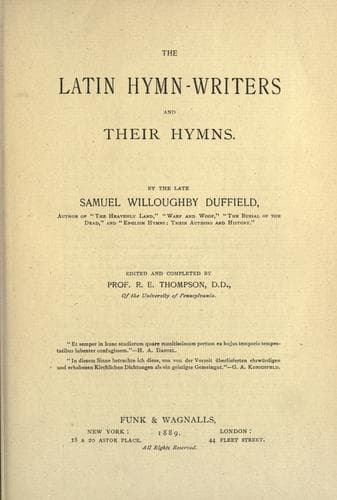
The Latin Hymn-writers and Their HymnsDuffield, Samuel Willoughby
Religion
The Latin Hymn-writers and Their Hymns
Duffield, Samuel Willoughby
Hymns, Latin -- History and criticism
Robert’s other sequences are six in number and of no importance. His
personal history is pathetic enough. He was the son of Hugh Capet; born
at Orleans in 970 and died at Melun, July 20th, 1031, having been sole
king since 996, though he had been crowned in 988. His first wife was
Susanne, an Italian princess; and we learn from his contemporary, Richer
of Rheims, that one of his first public acts was to repudiate her on the
plea that she was too old for him, and that he refused to restore her
dowry. His next marriage was with his distant cousin Bertha—a cousin
four times removed—the widow of the Count of Blois. This marriage was
inconvenient to the Emperor Otho, as it would have brought the House of
Capet into the line of succession to certain lordships in the old
Kingdom of Burgundy. So Pope Gregory V., the kinsman of Otho, required
Robert to give up Bertha, not because Susanne was still alive, but
because the Church forbade the marriage of cousins in even the fourth
degree. At first Robert refused, but when his kingdom was laid under an
interdict, he showed as little manhood in standing by his second wife as
he had shown humanity and justice to his first. Such a ban was too
severe to be borne and the king yielded, though Baronius says he tried
to take back his wife Bertha in spite of it all. His life and kingship
belong to French history, and can be found there. His disposition was
that of a monk and not of a monarch. He founded four monasteries and
built seven churches. He supported three hundred paupers entirely and a
thousand in part. His reign lasted—thanks to ecclesiastical
influence—for thirty-four years. It was troubled and not especially
pleasant; and for his third wife the king had married the handsome shrew
Constance, the daughter of William Count of Arles. Pious and excellent
man that he is reputed to have been, he had a natural son, Amauri, who
was great-great-grandfather to Simon de Montfort. Truly, when all is
said and done, Robert II. is hardly the author in whom we would like to
believe with all our hearts when we sing—
“Holy Spirit, come and shine
Sweetly in this heart of mine.”
_Per contra_, Hermann of Reichenau grows more interesting the more he is
studied. He has been so unfortunate as to be confused with other persons
in two or three cases. By Brander he is identified with Hartmann of St.
Gall, and the sequence _Rex omnipotens_ is taken from him.[8] The pretty
little sequence, _Veni Sancte Spiritus et reple_, which Königsfeld
thinks to be his, is doubtless no earlier than the fourteenth century
and by some anonymous composer who has merely imitated the great
masters.
Public-domain text, read in full here on John Shaqi.
Reviews
Reviews
No reviews yet
Be the first to share your thoughts on this work.
Elsewhere in the archive
Join the Discussion
Join the discussion
Sign in to leave a comment or review.
Sign InorCreate an account