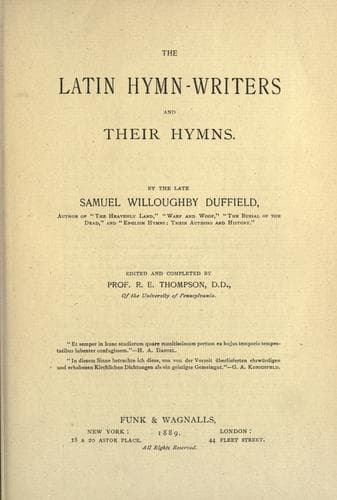
The Latin Hymn-writers and Their HymnsDuffield, Samuel Willoughby
Religion
The Latin Hymn-writers and Their Hymns
Duffield, Samuel Willoughby
Hymns, Latin -- History and criticism
I may appear to make a good deal too much of this matter of mediaeval
jealousy. But no student of those times needs to be told that the
jealousy between the various cloisters was excessive. There is a letter
of the Reichenau monk Gunzo, written in 960. (_Martene_, I., 296.) It is
addressed to the “holy congregation at Reichenau” and describes his
journey to St. Gall. The distance was great enough to exhaust the
learned brother; he was lifted off of his beast and carried in by
hospitable hands. Notwithstanding which he vents his indignation upon
their methods and their lack of scholarship. They are self indulgent;
they are a fraud on the face of the earth. _Nihil inde sed fraudis
molamina parabantur_—they do nothing there except contrive a great mass
of deception, says the angry Gunzo. They attacked him on his grammar;
and he attacked them in turn on their loquacity. The epistle is grimly
humorous at this distance of time; but the bitterness was altogether too
genuine to be pleasant.
Far away from the most of these noises—separated by the waters of the
lake from the trampling pilgrim-bands who went to and fro between the
East and West—Hermann of Reichenau passed his quiet hours. His convent
was rich. Its abbot was said to be able to journey to Rome and not sleep
anywhere on the way except upon his own soil. It had been founded in 724
under the auspices of Charles Martel. Such was the admirable situation
of this religious house—sufficient to itself in the midst of all
changes.
They buried Hermann in his ancestral tomb at Altshausen. In 1631 “three
bones” of him were exhumed and carried “by force” to the monastery of
Ochsenhausen, but who took them and who resisted the taking of them, we
are not told. These are the meagre particulars of a life gentle,
patient, and unassuming—the life of a scholar and of a poet—who mastered
great obstacles by the genius of faith.
Three hundred years before Christ there came into Ceylon the Buddhist
missionary Mahinda. The king received him kindly and built for him and
his monks a convent on the hill Mihintale, to the east of the royal
city. On the western face of this hill Mahinda had his own retreat cut
out from the living rock. Still can be seen—though after two thousand
years—this study in which the great teacher of Ceylon “sat and thought
and worked through the long years of his peaceful and useful life.”
Under the cool shadow of his rock, with his stone couch on which to
repose, and with the busy plain, so far removed from him, sending its
faint noises up from below, there wrought the sage. And there he died at
last and was buried in the neighboring Dagāba. Modern times have nearly
forgotten him, but no story of that valley or that island is complete
without his name.
Public-domain text, read in full here on John Shaqi.
Reviews
Reviews
No reviews yet
Be the first to share your thoughts on this work.
Elsewhere in the archive
Join the Discussion
Join the discussion
Sign in to leave a comment or review.
Sign InorCreate an account