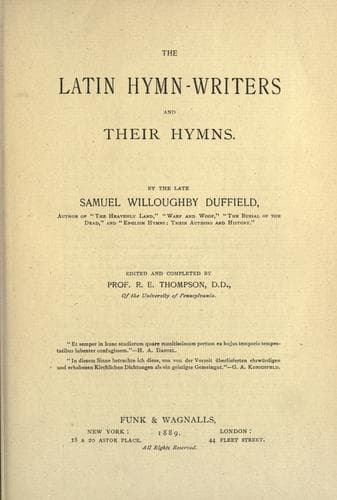
The Latin Hymn-writers and Their HymnsDuffield, Samuel Willoughby
Religion
The Latin Hymn-writers and Their Hymns
Duffield, Samuel Willoughby
Hymns, Latin -- History and criticism
And so, in this later manner, lived and died Hermann Count of Vöhringen,
who laid down earthly honors to take up the pursuit of heavenly glory;
who overcame peevishness of mind and weakness of body by faith and hope
and love; who looked out upon his times from this serene distance, and
who went to his last sleep beneath the shadow of the rock.
Note.—I am not ignorant that Jourdain (_Recherches critiques sur l’Age
et l’Origine des Traductions latines d’Aristote_. Paris, 1819 and 1843)
has attacked the ascription of translations of Aristotle from the Arabic
to our Hermann, denying that the cripple of Reichenau possessed any
knowledge of that tongue. Briefly stated his arguments are these: 1.
That Trithemius followed Jacobus of Bergamo in ascribing to H.
Contractus a knowledge of Arabic. 2. That Metzler (whom he calls
_Mezler_) has added the statement about the Poetics and Rhetoric. 3.
That every one else has followed these two authorities. 4. That “H.
Alemannus” wrote in _Toledo_, to which the other Hermann could not have
journeyed. 5. That the translations were by this “H. Alemannus” (Hermann
the German) who flourished in the first half of the thirteenth century.
It is enough of a reply to say: 1. That the concluding words of a
manuscript relate, not to its author, but to its transcriber. The MS.
mentioned by Jourdain and the other MS. in the Bibliotheque Royale of
the fifteenth century (viz., _Doctrina Matumeti, quae apud Saracenos
magnae auctoritatis est, ab Hermanno latine translata._ Cod. MS., No.
6225) are both later than their original date. This second MS. may be by
Hermann de Schildis, a monk of the thirteenth century. 2. Every one has
not “followed” the authority of Metzler and Trithemius. The “Anonymus
Mellicensis” (twelfth century) enumerates treatises by Hermannus
Contractus upon Computation, Astronomy, Physiognomy and Poetry, which at
least imply that Aristotle had largely affected his studies. 3. It is
notable also to find H. _Alemannus_ quoting Cicero in his two
introductions, when we know H. _Contractus_ to have been very fond of
Cicero. 4. H. Alemannus says that he has met great “impediments” and
“difficulties” in accomplishing this translation, and that the
difference between Latin and Arabic poetry forbade a poetical rendering.
Which would coincide with H. Contractus’s personal obstacles and with
his natural desire as a poet to attempt a rendering in verse. 5. H.
Alemannus refers to “Johannes Burgensis” (John of Burgau, in Suabia) as
a bishop and the king’s chancellor and his personal friend and the
promoter of this work. I cannot find “John of Burgau;” but H. Contractus
was a Suabian, and Suabia is very near to Reichenau. H. Contractus was
also closely associated with Conrad and Henry III., whose lives he
wrote.
Public-domain text, read in full here on John Shaqi.
Reviews
Reviews
No reviews yet
Be the first to share your thoughts on this work.
Elsewhere in the archive
Join the Discussion
Join the discussion
Sign in to leave a comment or review.
Sign InorCreate an account