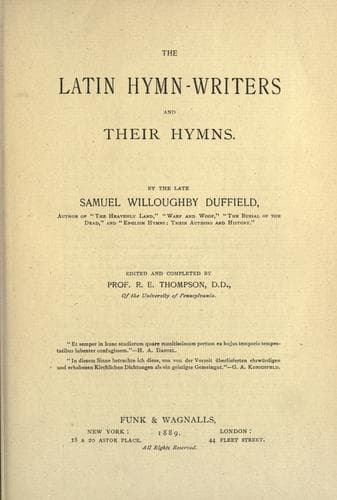
The Latin Hymn-writers and Their HymnsDuffield, Samuel Willoughby
Religion
The Latin Hymn-writers and Their Hymns
Duffield, Samuel Willoughby
Hymns, Latin -- History and criticism
Further to speak of Hildebert, it can be said that he, like others, took
his share of imprisonments, confiscations, and exiles.
Trench quotes from his poetry two compositions in hexameter and
pentameter—classic in language, but not always classic in prosody; and
two complete poems, one of which is the famous hymn, and which commences
“_A et Ω magne Deus._”
The other is a vision and lament over the Church of Poitiers. Of this
the editor says: “I know of no nobler piece of versification, nor more
skilful management of rhyme in the whole circle of Latin rhymed poetry.”
It begins
“_Nocte quadam, via fessus_”—
an important hint for a person who wishes to find anything in the German
anthologies, where, as a rule, the indexing is hideous and the
arrangement is heartrending, and the poems are designated, hit-or-miss,
by their initial line.
The poem _De Exilio Suo_, beginning
“_Nuper eram locuples, multisque beatus amicis_,”
is an example of the classic measures into which I have tried to shape
my own rendering, although I have copied Hildebert even in his
inaccuracies and repetitions:
UPON HIS EXILE.
Once I was rich and blessed with friends beyond measure,
And, for awhile, Fortune was prosperous too.
You would have said that the gods had heard my petition,
And that success had taught me to conquer anew.
Often I said to myself: “What means this wealthy condition?
What does it claim, this swift great store of my gain?”—
Woe to myself! for faith and confidence perish;
Even my property teaches how I have heaped it in vain!
Lightly the wing sweeps men and the things that they cherish,
And from the highest station ruin pours down to the plain.
What you possess to-day, perchance you will lose by to-morrow,
Or, indeed, as you speak, it ceases perhaps to be yours.
These are the tricks of our fate; and haughtiest kings to their
sorrow,
And humblest slaves shall find that no future endures.
Lo, what is Man! and what has he right to inherit?
What is the thing that his wretchedness claims as its own?
This, this only is man; the years press down on his spirit
Always in saddest condition to utter his final groan.
It is man’s lot to have nothing—in nakedness coming; and going
Back to his mother’s breast to bear her no riches again.
It is man’s lot to decay, his dust on the desert bestowing,
And by sad steps to climb to the pyre of his pain.
Such is his heirship of good, and here upon earth he may gather
Nothing more certain than these, the spoils of a vanishing fate.
Riches and honor may greet him, yea, be his servants the rather;
Wealthy at morn though his station, poor shall at night be his
state.
Nor can a man discern the permanent law of possession
Save as he seeks to discover the nature of mortal affairs.
Yet does God give them their law, conferring them through his
concession
Public-domain text, read in full here on John Shaqi.
Reviews
Reviews
No reviews yet
Be the first to share your thoughts on this work.
Elsewhere in the archive
Join the Discussion
Join the discussion
Sign in to leave a comment or review.
Sign InorCreate an account