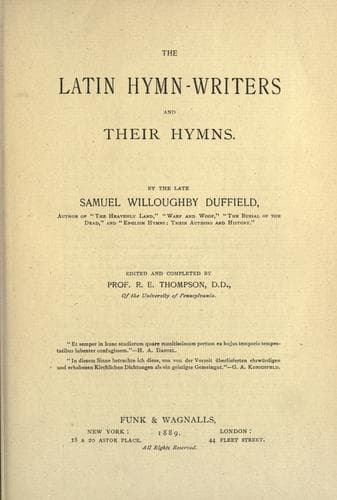
The Latin Hymn-writers and Their HymnsDuffield, Samuel Willoughby
Religion
The Latin Hymn-writers and Their Hymns
Duffield, Samuel Willoughby
Hymns, Latin -- History and criticism
The poem is, as Chancellor Benedict has well said, almost epic in its
completeness. And I can do no better than to summarize it in his own
words—for he linked his name to it by a translation which he published
in 1867: “Its beginning [is] the knowledge of God—_Fides orthodoxa_—the
true creed, as to the Three Persons of the Holy Trinity, exhibiting
their attributes as the foundation of the Christian character; its
middle, the weakness, the trials, and the temptations of the Christian
life, in its progress to perfect trust and confidence in God and
assurance of His final grace; its end, the joys and glories of the
heavenly home of the blessed.” It has been greatly neglected, as any one
will find who looks for it outside of the most recent collections of
sacred Latin poetry. Why this has been so, except because the praise of
Mary and of the saints was more congenial to collectors than a lofty and
pure spiritual fervor, it is not easy to discern. Hugo of St.
Victor—Hildebert’s contemporary—does actually quote six lines, but calls
the author _quidam_, or, as we would say, “somebody,” in referring to
these half dozen verses extracted to give point to his own discourse.
Yet Hildebert was in his day a most important personage, not below the
persecution of a king of England, and not above a quarrel with a king of
France. But he and the king were reconciled at last, and with honor.
That Professor Longfellow is not indebted to Trench’s text for his
little quotations, is shown by a curious fact. The _Sacred Latin Poetry_
of Archbishop (then Dean) Trench was first published in 1849, and the
“Golden Legend” appeared in Boston in 1851—the time seeming to indicate
that the poet had been reading in the small book of the prelate. But
Professor March has very acutely noticed that the Church of England, in
the person of its editor, did a great deal of expurgation, and that the
lines
“Cujus claves lingua Petri,
Cujus cives semper laeti,”
are not included by Trench at all! It was not proper, the Dean thought,
to encourage Romish superstitions, and so Peter and his keys were
omitted. It is not impossible that Longfellow took his text from a
little volume published at Auburn, N. Y., in 1844, which contains “The
Hymn of Hildebert and the Ode of Xavier, with English Versions,”
probably by Dr. Henry Mills, professor in the Theological Seminary at
Auburn, who also published a volume of translations of German hymns
(1845 and 1856). Dr. Mills reprints the entire hymn from Ussher, but
ignores in his translation the lines
“_Deus pater tantum Dei_
_Virgo mater est, sed Dei._”
The book is memorable as the first American publication in this field.
Besides the American translations by Dr. Mills and Chancellor Benedict,
there are English versions by Crashaw, by John Mason Neale, and, best of
all, by Herbert Kynaston in the _Lyra Mystica_ (London, 1869), copied
from his _Occasional Hymns_.
Public-domain text, read in full here on John Shaqi.
Reviews
Reviews
No reviews yet
Be the first to share your thoughts on this work.
Elsewhere in the archive
Join the Discussion
Join the discussion
Sign in to leave a comment or review.
Sign InorCreate an account