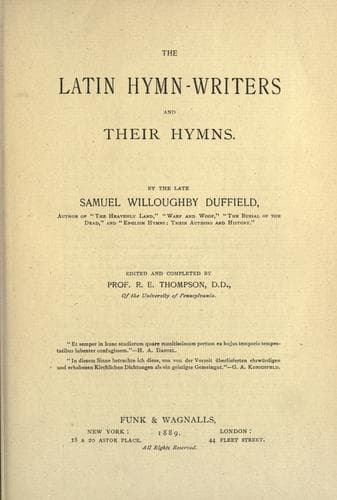
The Latin Hymn-writers and Their HymnsDuffield, Samuel Willoughby
Religion
The Latin Hymn-writers and Their Hymns
Duffield, Samuel Willoughby
Hymns, Latin -- History and criticism
For several years this news was to men the staple of all conversation.
The body of their own duke was finally brought back from Palestine to
his ancient heritage, and laid, by his own desire, in the cemetery of
the poor monks of Citeaux. There, in this comparatively recent monastery
near Dijon, he had selected his last home, in preference to many more
opulent and renowned establishments. The son of Burgundy’s vassal
Tesselin beheld this and other incidents. His brothers went to the wars
with the next duke, but he himself grew less and less inclined toward
such pursuits. Books formed his world. His cell was afterward said to be
stored with them; and he obtained easily the credit of being the best
instructed person of his time in the Bible and in the works of the
fathers of the Church.
And already these tendencies were aroused in the youth of eighteen or
nineteen years who had begun the old-fashioned austerities on his own
account. We are not surprised to find him neck-deep in ice-water; stung
into intellectual vigor by the recent victory of Abelard over William of
Champeaux; aroused into an actual preaching fervor, in which he
denounces the sins of the age; continually mindful of his dead mother
Alith’s prayers, and finally resolved upon entering the monastic order
and upon carrying all his friends and relations with him.
That singular mastery of other minds, which was his at every period
henceforth, now displayed itself. It did not matter that his brother
Guido had a wife and family; nor that his brother Gerard loved to fight
a good deal better than he loved to pray. Into the cloister they must
go! Gerard indeed was something after the manner of Lot’s wife, disposed
to look back. But his brother touched him on the side, and by some
strange prescience or happy guess, predicted to him a spear-wound, which
actually happened. On being thus remarkably warned, the soldier relented
as they carried him wounded off the field, and cried, “I turn monk, monk
of Citeaux.” This was the Gerard over whom, long afterward, Bernard
delivered that touching sermon, where he branched out from the Song of
Solomon (1:5) to declare that this body “is not the mansion of the
citizen, nor the house of the native, but either the soldier’s tent or
the traveller’s inn;” and then poured forth his full heart in a tide of
uncontrollable and lofty grief.
So the youth marched into the poor monastery of Citeaux, where scanty
food, rough clothing, harsh surroundings and occasional epidemic
disorders had nearly disheartened and broken up the company of monks.
Stephen Harding, their English abbot, was proudly indifferent to all
patronage; but he was not so blind as not to perceive that Bernard, with
thirty captives of the bow and spear of his eloquence, was a valuable
addition to a depleted community.
Public-domain text, read in full here on John Shaqi.
Reviews
Reviews
No reviews yet
Be the first to share your thoughts on this work.
Elsewhere in the archive
Join the Discussion
Join the discussion
Sign in to leave a comment or review.
Sign InorCreate an account