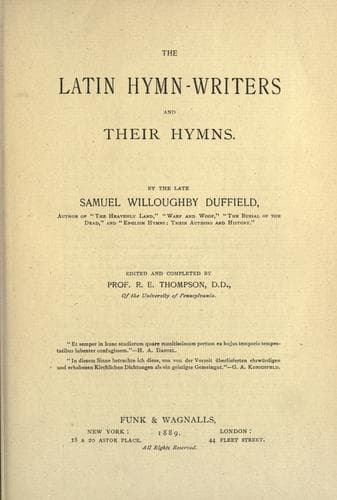
The Latin Hymn-writers and Their HymnsDuffield, Samuel Willoughby
Religion
The Latin Hymn-writers and Their Hymns
Duffield, Samuel Willoughby
Hymns, Latin -- History and criticism
These Cistercians, then and always, were rigidists. Up they got at two
in the morning to prayer and “matins;” and for full two hours were busy,
in a cold dark chapel, over them. Then, with the first dawn of light,
out again to “lauds.” Before this service, and after it, the monk’s time
was fairly his own; but at two o’clock he dined, at nightfall he had
“vespers,” and at six or eight (according to the season) came
“compline,” and then immediately the dormitory and bed. Such was the
life, with a little more of it on Sundays, and with sermons interspersed
at intervals. There is no mention of breakfast or supper!
And in such a life the ecstatic, mystical character of Bernard rose into
visions and prophecies. His body was nearly subjugated, and his taste,
and, indeed, all his senses, appeared to have deserted him. He watched,
he dug, he hewed and carried wood; he kept the very letter, and more
than the letter of his monastic rule. And yet, as Morison acutely
observes, this very abstraction from people and things gave him that
delight in nature from which, so often in the future, he was to catch
the illustration or the inspiration of his discourse. “Beeches and
oaks,” he said, “had ever been his best teachers in the Word of God.”
But now Citeaux (suddenly become prosperous) must colonize; and who so
fit to lead the swarm from the gates and found the new hive as this same
Bernard? Into his hands Abbot Stephen puts the cross, and he and his
twelve companions march solemnly across the interdicted boundaries of
their little Cistercian home, and nearly a hundred miles to the
northward. There he chooses a place which exhibits, as Bernard’s actions
generally do, the far-sighted sagacity which takes mean and worthless
matters and makes them what, with right handling, they are able to
become. It is a valley—the “Valley of Wormwood.” It is grown up with
underbrush and is a haunt of robbers. But here, with the river Aube
winding down between the hills, with the hills themselves capable of
culture, and with the future of this little vale revealed to his
prophetic eye, he sets his cloister and calls it Clairvaux—“Fair
Valley,” or “Brightdale.”
Public-domain text, read in full here on John Shaqi.
Reviews
Reviews
No reviews yet
Be the first to share your thoughts on this work.
Elsewhere in the archive
Join the Discussion
Join the discussion
Sign in to leave a comment or review.
Sign InorCreate an account