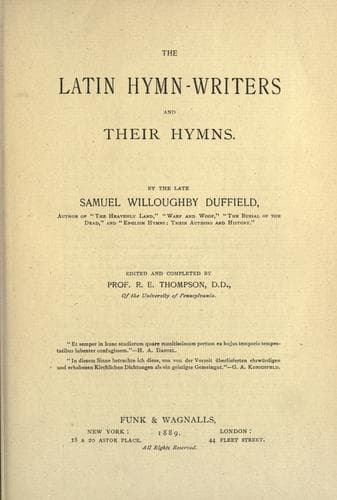
The Latin Hymn-writers and Their HymnsDuffield, Samuel Willoughby
Religion
The Latin Hymn-writers and Their Hymns
Duffield, Samuel Willoughby
Hymns, Latin -- History and criticism
From the foreground of the waving banners and the flashing arms of the
Crusaders, of the dark throng of the chanting monks, and of feudal
pageantry and glitter—and from that background of dead uniformity which
equally characterized those mediaeval times—emerges a figure unique and
notable. It is that of a man in the prime and pride of life—lofty in
stature, handsome in face, captivating in address. He is already a tried
debater and an unsurpassed logician. He has Aristotle at the tip of his
tongue; he has read much and thought a little, and his ambition is
great.
Such a man came one day into the lecture hall of William of Champeaux at
Paris. It was in the early part of the twelfth century, and William was
the most celebrated teacher of the period, his “doctrine of universals”
being accepted almost as though it were inspired. But this morning,
while the master lectured and the disciples drank in his words without
criticism or debate, the visitor stirred uneasily in his place. When the
lecture closed he availed himself of the usual freedom to ask some
questions. To William’s dogmatic answers the stranger in his turn
proposed shrewd difficulties. It was no longer the harmony of teacher
and taught, but the clash of two rival minds maintaining opposite
systems of logic. And in that short struggle William the Archdeacon went
down before the free lance of Peter Abelard, the rustic challenger from
Palais (Le Pallet) in Brittany. And from that agitation went out the
widening circles whose story we are now to note, and whose latest
ripples break faintly on a tomb in Père-la-Chaise visited by thousands
of modern tourists. Few tales are sadder or more suggestive.
The name of Abelard is variously spelled. It appears in divers
authorities as Abelard, Abaelard, Abaielardus, Abailard, Abaillard,
Abelhardus, and Abeillard. The true name (on the authority of Ch. de
Rémusat) was, however, not Abelard, but Beranger or Berenger; and the
future controversialist was christened Pierre or Peter. His birthplace
is near Nantes, the house being represented a few years ago by a square
brier-grown ruin back of the church. The date of his birth is given as
1079—a period when the world was feudal and military. But this lad was
born for debate and not for battle. It may even be seriously doubted if
he ever possessed much physical courage of a sort to stand the rough
shock of actual warfare. He preferred the method of those who
intermeddle among metaphysical subtleties to those who must keep sword
edges sharp and armor furbished. His delight was to dispute, to be
engaged in undertakings
“Whose chief devotion lies
In odd perverse antipathies;
In falling out with that or this
And finding somewhat still amiss.”
Public-domain text, read in full here on John Shaqi.
Reviews
Reviews
No reviews yet
Be the first to share your thoughts on this work.
Elsewhere in the archive
Join the Discussion
Join the discussion
Sign in to leave a comment or review.
Sign InorCreate an account