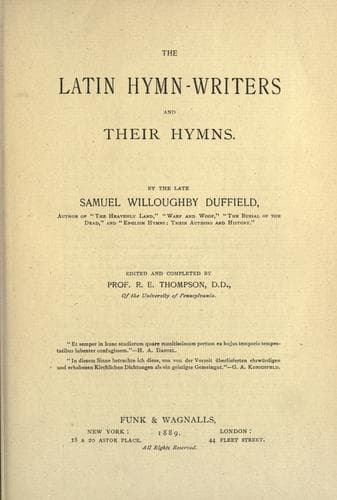
The Latin Hymn-writers and Their HymnsDuffield, Samuel Willoughby
Religion
The Latin Hymn-writers and Their Hymns
Duffield, Samuel Willoughby
Hymns, Latin -- History and criticism
He had lived to see the Knights Templars, which had received his own
especial approval, become one of the most famous orders on the globe.
The Knights Hospitallers had been incorporated in 1113, and the Templars
were founded in 1118 by Hugo de Paganis and others. But in 1128, at the
Council of Troyes, there were but nine of them, all told, to keep their
vow of “chastity, obedience, and poverty,” to “guard the passes and
roads against robbers,” and to “watch over the safety of pilgrims.” Hugo
then appealed to Bernard, and by his influence the council recognized
this weak thing, destined so soon to be a mighty force, and which
combined two of the strongest of our instincts—that to fight and that to
pray. And now as in his old age he saw the corruption which was creeping
into it and into other agencies on which his heart had been set, he
relaxed no atom of his vigilance. He had seen the failure of his
crusade, but it did not much affect him. His thoughts were now of
heaven, and his watching was that he might be prepared to enter its
gates. His principal friends had all died; Suger, in 1150, Theobald of
Champagne, in 1152, and Pope Eugenius, his loved disciple, in 1153.
It was in this year that Bernard also made himself ready to go. On
January 12th he said the Lord’s Prayer, and then, raising up what his
admirers were wont to call his “dove-like” eyes, he prayed that God’s
will might be done. And so, quietly and peacefully, he passed away. He
has left behind him much as an ecclesiast, but more as a poet. I hold
Bernard to be the real author of the modern hymn—the hymn of faith and
worship. The poetry of Faber, which is now so near to the heart of the
Church, is peculiarly in this key. The _Salve Caput cruentatum_ came to
us through Paul Gerhardt, and has become (through the translation of Dr.
J. W. Alexander, a man of kindred spirit with Bernard) our
“O sacred head, now wounded.”
Gerhardt’s own hymn-writing—the most efficient, except Luther’s, in the
German tongue—is wonderfully affected by Bernard. The _Jesu dulcis
memoria_ was rendered by Count Zinzendorf and became famous among those
spiritual souls, the Moravians. And Edward Caswell’s translations—as I
have already noticed—are supremely fine in spirit and in expression. I
shall not attempt here what has been so capitally done already. The
Church universal has made Bernard her own; and the very translations of
his verses have been half-inspired. And while we sing,
“Jesus, the very thought of thee
With sweetness fills my breast,”
we shall sing “with the spirit and with the understanding,” the very
strain that the Abbot of Clairvaux was sent on earth to teach! They
canonized him in 1174—but it is better to have written a song for all
saints than to be found in any breviary.
CHAPTER XIX.
ABELARD.
Public-domain text, read in full here on John Shaqi.
Reviews
Reviews
No reviews yet
Be the first to share your thoughts on this work.
Elsewhere in the archive
Join the Discussion
Join the discussion
Sign in to leave a comment or review.
Sign InorCreate an account