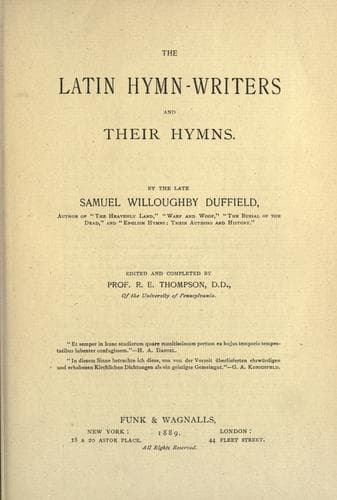
The Latin Hymn-writers and Their HymnsDuffield, Samuel Willoughby
Religion
The Latin Hymn-writers and Their Hymns
Duffield, Samuel Willoughby
Hymns, Latin -- History and criticism
Heloise was probably the better educated of the two. She was the child
of unknown parents. Bayle asserts that she was the daughter of a priest,
and his facilities and laboriousness respecting such abstruse
particulars no one will question. The authority from which he is
possibly quoting, says that this priest was John “Somebody” (_nescio
cujus_) and a canon of the same cathedral with Fulbert at Paris.
Doubtless the trace of her ancestry is utterly lost to us beyond these
meagre items. Even Fulbert’s alleged relationship has been questioned.
But the scholarship of Heloise speaks for itself in a terse, sparkling
Latin style, which is as pleasant beside Abelard’s lumbering sentences
as a bright mountain brook beside a turbid and turbulent stream. Count
de Bussy-Rabutin—no mean critic—has put on record that he never read
more elegant Latin. She also understood Greek and Hebrew, with neither
of which, strange to say, was Abelard acquainted. And at first blush it
would seem that the teacher should have been the pupil.
Absolute justice requires that the ugly and disgraceful slurs in the
_Historia Calamitatum_, and even in the correspondence, should not be
overlooked. Here is what will serve for a fair example. He says of her,
_Quae cum per faciem non esset infima, per abundantiam litterarum erat
suprema_—while she was not exactly the worst-looking of them, she was
the best educated; and therefore he selected her! The _spretae injuria
formae_ never went further than this. But this is by no means the
solitary instance of that low snarl in which the currish nature of the
Breton rustic now and then indulged.
What, then, could have been the spell by which this charming woman drew
Christendom after her? Popes and bishops called her “beloved daughter,”
priests entitled her “sister,” and all laymen laid claim to her as
“mother.” If she were not so beautiful as some authorities positively
state, she must certainly have been marvellously captivating. But
chiefest of her many graces was her crowning loyalty and love. It showed
itself in perfect sympathy, in entire self-devotion. Michelet, indeed,
has observed that the legend of Abelard and Heloise is all that has
survived in France out of the story of the Middle Ages.
Nor has the unanimity of literary judgment upon these lovers been less
remarkable than the interest which they have inspired. With one voice
Abelard is condemned and with one voice Heloise is extolled. “She was,”
says a brilliant writer, “a great, heroic woman, one of those formed out
of the finest clay of humanity.” “With the Grecian fire,” says another,
“she had the Roman firmness.” And even the rude picture which the
mechanical touch of Alexander Pope has painted, leaves to us in the
“Epistle of Heloise” a trace of the same beauty, and affords one line—
“And graft my love immortal on thy fame”—
Public-domain text, read in full here on John Shaqi.
Reviews
Reviews
No reviews yet
Be the first to share your thoughts on this work.
Elsewhere in the archive
Join the Discussion
Join the discussion
Sign in to leave a comment or review.
Sign InorCreate an account