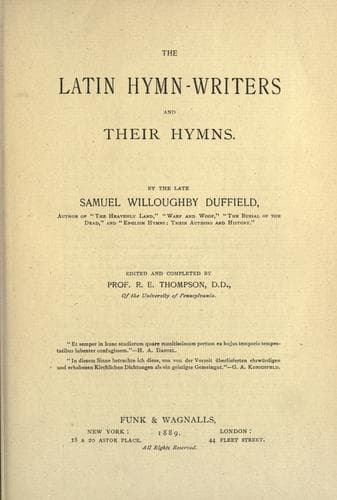
The Latin Hymn-writers and Their HymnsDuffield, Samuel Willoughby
Religion
The Latin Hymn-writers and Their Hymns
Duffield, Samuel Willoughby
Hymns, Latin -- History and criticism
which only needs to be reversed in order to be prophetic. Morison’s
tribute is both nobler and more acute, for he testifies, “She walked
through life with ever-reverted glances on the glory of her girlish
love.” It was the same thought which Dante—after Boethius—puts into the
lips of Francesca—
“There is no greater sorrow
Than to be mindful of the happy time
In misery, and that thy Teacher knows.”
Nay, it is even the very cameo out of Tennyson:
“As when a soul laments, which hath been blessed,
Desiring what is mingled with past years,
In yearnings that can never be expressed
By sighs, or groans, or tears.”
This is the heart which Abelard won. Winning it he won, and forever
held, the woman whose it was. From that moment she merged her whole
existence in his with a complete and utter abandonment of self, to the
perfectness of which let her epistles from the Paraclete bear testimony.
Across this story of undeviating devotion Abelard’s vanity, pride, and
coarseness are written with smears and stains, like an illiterate monk
who blots his comments upon a precious missal full of saints and angels.
For, first of his offences, he revealed this love of his by really
becoming a troubadour. He composed verses in the Romance tongue,
recounting their loves, and set them to such stirring tunes that all the
world was soon singing them. Hence grew the legend that the “Romance of
the Rose” (_Roman de la Rose_) was his composition. It undoubtedly
contains their story, but it was not his work; it belongs to William de
Loris and Jean de Meung. But, as for Heloise, she was delighted. What
would have been a crown of sorrow to other women was to her a crown of
joy. She even announced to Abelard “with the utmost exultation” the
advent of that unhappy being christened Astrolabe and destined to pass
his forsaken and lonely existence shut up in a cloister. That people
sang of this love; that it went to the ends of the earth; that nothing
could prevent its being known—these were the happinesses of Heloise. Of
the merit of the songs we cannot ourselves decide. They were originally
anonymous, and only those familiar with the crabbed French of that
period may hope to find them again.
Public-domain text, read in full here on John Shaqi.
Reviews
Reviews
No reviews yet
Be the first to share your thoughts on this work.
Elsewhere in the archive
Join the Discussion
Join the discussion
Sign in to leave a comment or review.
Sign InorCreate an account