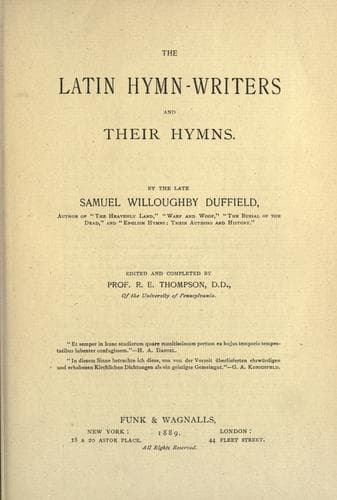
The Latin Hymn-writers and Their HymnsDuffield, Samuel Willoughby
Religion
The Latin Hymn-writers and Their Hymns
Duffield, Samuel Willoughby
Hymns, Latin -- History and criticism
The abbot says to her, after describing the daily life of Abelard, “How
holily, how devoutly, in what a catholic spirit he made confession,
first of his faith and then of his sins! ... Thus Master Peter finished
his days, and he who for his knowledge was famed throughout the world,
in the discipleship of Him who said, ‘Learn of Me, for I am meek and
lowly in heart,’ persevered, in meekness and humility, and, as we may
believe, passed to the Lord.” It is in such language that this
benevolent man addresses his “venerable and very dear sister,”
concerning, as he tenderly puts it, her “first husband in the Lord.” And
doubtless this same Abelard became, at the last, a little child, who
through much tribulation had unlearned his haughty and selfish temper,
and had gone back from subtleties and logic to say in all simplicity,
Abba, Father! And it is not less interesting for us to discover in the
second epistle of Heloise to Peter of Cluny, that the mother’s heart
yearns over her boy, and that she commends Astrolabe to the care and
protection of his father’s benefactor, a trust which, in his next
letter, Peter accepts and promises to discharge.
Of the poetry of Abelard much has unquestionably been lost. His
troubadour ballads may have been conveniently suppressed; it is often
the fate of wise men’s lighter productions. And his hymns were for long
years untraced, except in the instance of the _Mittit ad virginem_ and
of another upon the Trinity, which was ascribed to him, but is now
accredited to Hildebert. A very pretty poem, _Ornarunt terram germina_,
preserved by Du Meril (_Poesies Populaires Lat._, p. 444) is given in
the collection of Archbishop Trench and again in that of Professor
March. Even in English its grace and daintiness do not entirely escape
us, and they show how possible it was for him to have written the
love-songs which celebrated Heloise.
The earth is green with grasses;
The sky is filled with lights—
Sun, moon, and stars. There passes
Vast use through days and nights.
On either hand upbuilded,
Arouse, O man, and see!
Those heavenly realms are gilded
By help which shines for thee.
The suns of winter cheer thee
For lack of fire below;
While the bright moon draws near thee,
With stars, thy path to show!
Leave pride her ivory spaces;
The poor man on the grass
Looks up, from fragrant places
By which the song-birds pass.
The rich, with wasteful labor,
(For vaulted domes shall fall,)
Mocking his poorer neighbor,
Paints heaven within his hall.
But in that open chamber
Where all things fairest are,
Let the poor man remember
How God paints sun and star.
So vast a work and splendid
Is nature’s more than man’s!
No pains nor cost attended
Those age-enduring plans!
The rich man keeps his servant,
An angel guards the poor,
And God sends stars observant
To watch above his door!
Public-domain text, read in full here on John Shaqi.
Reviews
Reviews
No reviews yet
Be the first to share your thoughts on this work.
Elsewhere in the archive
Join the Discussion
Join the discussion
Sign in to leave a comment or review.
Sign InorCreate an account