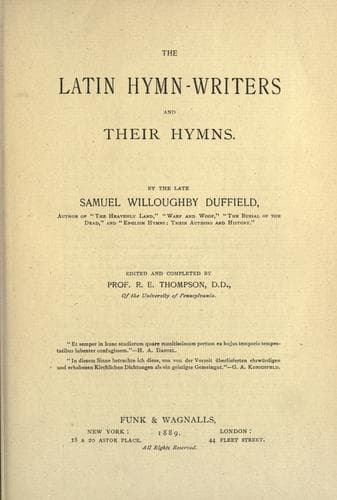
The Latin Hymn-writers and Their HymnsDuffield, Samuel Willoughby
Religion
The Latin Hymn-writers and Their Hymns
Duffield, Samuel Willoughby
Hymns, Latin -- History and criticism
These forms brought on a controversy with Bernard, who did not like
them. The letters also are still extant, often translated, but never in
anything except the original Latin, speaking out the real nature of the
writers. On the part of Heloise they reveal the depth of an unending
love. On the part of Abelard they are as cold and occasionally as cruel
as anything to which a translator can turn his pen. After a careful
survey of their contents the conclusion is irresistible that Heloise is
a woman whose lofty love carries with it unhesitatingly the mind, the
will, the senses—everything. Her faults are the faults of her time and
of her teaching, not of her soul. But, by the survival of its most
forcible elements, Abelard’s character has been developed into a selfish
coldness both unnatural and ungrateful. As a man, at this stage of his
career, one abhors and pities him.
Presently upon the dead colorlessness of this “burned-out crater healed
with snow,” the red light of a new controversy is cast. In this final
struggle the redoubtable force of the splendid debater flashed up once
more. But he was defeated by Bernard at Sens (1140), and whether this
defeat was by fair logic or by the hostile spirit of the age it does not
matter. Defeated he was, and he rushed out declaring that he would
appeal to Rome. Happily his way led him through Cluny, and there good,
large-hearted, and large-bodied Peter the Venerable took him in. For the
first time, perhaps, in all his life he came into close relations with a
man genuinely great. And Peter of Cluny himself wrote to the Pope;
detaining Abelard meanwhile by kind assiduities, in that genial cloister
whose humanity cherished neither bigotry nor license. Later he even
reconciled the two disputants, and the broken and weary debater died at
last (April 21st, 1142) at St. Marcel, whither he had been sent for
change of climate by the care of his hospitable friend.
There is a painting—a true artist’s conception, but a mere daub in
fact—which hangs in a New York village and which represents a dead
knight stretched upon the ground. He lies upon his back on the sodden
earth in the melting snow. The sky above him is of a dull and awful
gray, and the carrion birds are flying in a long, hurrying line to join
those already at the feast. A broken sword is strained in his right
hand, his armor is hacked and darkly spotted with mire and blood, and
his feet have fallen into a little stream. So would have fallen Abelard
but for the charity and mercy of Peter the Venerable. Remembering all
that he had been it is somewhat comforting to read of his last days. For
certain letters passed between Peter of Cluny and Heloise, and these,
too, are extant and accessible.
Public-domain text, read in full here on John Shaqi.
Reviews
Reviews
No reviews yet
Be the first to share your thoughts on this work.
Elsewhere in the archive
Join the Discussion
Join the discussion
Sign in to leave a comment or review.
Sign InorCreate an account