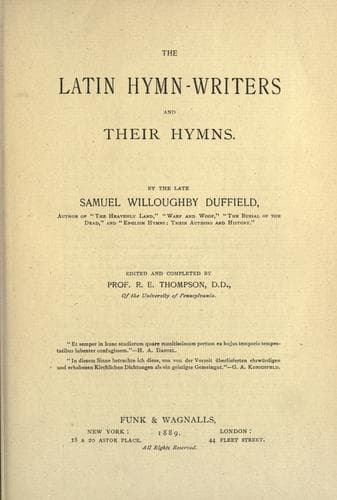
The Latin Hymn-writers and Their HymnsDuffield, Samuel Willoughby
Religion
The Latin Hymn-writers and Their Hymns
Duffield, Samuel Willoughby
Hymns, Latin -- History and criticism
It is strikingly characteristic of the superficial nature of many
studies in Latin hymnology, that Oehler apparently thought of nothing
else that might be in the _codex_, but proceeded at once to publish
eight of the recovered hymns. These, attracting the notice of Monsieur
Cousin, he purchased a full transcript of the _libellus_ at a “fair
price” from the discoverer. It was, however, reserved for Émile Gachet,
a Belgian, to “give a not unlucky day to paleography” in the course of
which he lighted upon this same _codex_ and found it still to contain
the larger part of an epistle treating of Latin hymnology, addressed to
Heloise, and announcing the hymns of which it was the preface. Thus the
identification was perfect, and the introductions and the hymns are
again joined with the other works of their authors. In 1838 a set of
_Planctus_—“Lamentations”—had been found in the Vatican Library. They
are moderate in merit, and these new pieces were therefore invaluable in
determining Abelard’s rank as a poet. In the main, his hymns are
didactic and cold. But there is at least one which has held its place
anonymously in the service of the Church and upon this his reputation
may safely rest. It was translated by Dr. Neale from the imperfect text
of a Toledo breviary, and it can be found in _Hymns, Ancient and Modern_
(No. 343), and in Mone (_Lat. Hym. des Mittelalters_, I., 382). In the
Paraclete Breviary it is “xxviii., _Ad Vesperas_.”
O quanta, qualia sunt illa sabbata,
Quae semper celebrat superna curia!
Quae fessis requies, quae merces fortibus,
Cum erit omnia Deus in omnibus.
Vere Jherusalem illic est civitas
Cujus pax jugis est summa jucunditas,
Ubi non praevenit rem desiderium,
Nec desiderio nimis est praemium.
Quis rex! quae curia! quale palatium!
Quae pax! quae requies! quod illud gaudium!
Hujus participes exponant gloriae
Si, quantum sentiunt, possint exprimere.
Nostrum est interim mentem erigere,
Et totis patriam votis appetere,
Et ad Jherusalem a Babilonia,
Post longa regredi tandem exilia.
Illic, molestiis finitis omnibus,
Securi cantica Syon cantabimus,
Et juges gratias de donis gratiae
Beata referet plebs tibi, Domine.
Illic ex sabbato succedet sabbatum,
Perpes laetitia sabbatizantium,
Nec ineffabiles cessabunt jubili,
Quos decantabimus et nos et angeli.
Oh what shall be, oh when shall be, that holy Sabbath day,
Which heavenly care shall ever keep and celebrate alway;
When rest is found for weary limbs, when labor hath reward,
When everything, forevermore, is joyful in the Lord?
The true Jerusalem above, the holy town, is there,
Whose duties are so full of joy, whose joy so free from care;
Where disappointment cometh not to check the longing heart,
And where the soul in ecstasy hath gained her better part.
Public-domain text, read in full here on John Shaqi.
Reviews
Reviews
No reviews yet
Be the first to share your thoughts on this work.
Elsewhere in the archive
Join the Discussion
Join the discussion
Sign in to leave a comment or review.
Sign InorCreate an account