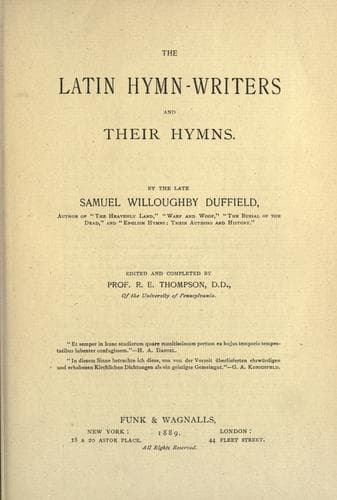
The Latin Hymn-writers and Their HymnsDuffield, Samuel Willoughby
Religion
The Latin Hymn-writers and Their Hymns
Duffield, Samuel Willoughby
Hymns, Latin -- History and criticism
O glorious King, O happy state, O palace of the blest!
O sacred peace and holy joy and perfect heavenly rest.
To thee aspire thy citizens in glory’s bright array,
And what they feel and what they know they strive in vain to say.
For while we wait and long for home, it shall be ours to raise
Our songs and chants, and vows and prayers, in that dear country’s
praise;
And from these Babylonian streams to lift our weary eyes,
And view the city that we love descending from the skies.
There, there, secure from every ill, in freedom we shall sing
The songs of Zion, hindered here by days of suffering,
And unto thee, our gracious Lord, our praises shall confess
That all our sorrow hath been good, and thou by pain canst bless.
There Sabbath day to Sabbath day sheds on a ceaseless light,
Eternal pleasure of the saints who keep that Sabbath bright;
Nor shall the chant ineffable decline, nor ever cease,
Which we with all the angels sing in that sweet realm of peace.
The rhythm of the Trinity, previously mentioned, is so good that it is
usually, and, it may be, correctly, ascribed to Hildebert of Lavardin;
and the _Planctus Varii_ have really something more than that
“inconsiderable merit” which Archbishop Trench allows to them. They are
irregular in form and metre, and their subjects (which evidently reflect
their author’s feelings) are: The Wail of Dinah; Jacob’s Lament over
Joseph and Benjamin; The Sorrow of the Virgins over Jephthah’s Daughter;
The Israelites’ Dirge over Samson; The Grief of David over Abner and his
Elegy upon Saul and Jonathan. Abelard also composed a long poem to
Astrolabe, giving him plenty of good counsel in fair pentameter, but in
rather prosaic phrases. Some of it sounds like Lord Chesterfield’s
worldly wisdom, and there are portions of the production which are
plainly affected by the soured and saddened spirit of the author. “There
is nothing,” he tells the poor, forsaken lad, “better than a good woman,
and nothing worse than a bad one,” and, “as in all species of rapacious
birds,” the female is the most to be dreaded!
Thus the poems which we possess number one hundred and two all told. But
for ordinary readers not more than five—if we exclude the present
correct Latin form of the _O quanta qualia_—are available in the
original, and these are scattered through three or four collections. An
unkind fate has still pursued these poor relics of the man who took
shelter under the broad wing of Peter the Venerable, and who, by having
escaped into such sanctuary, has barred out from thenceforth all
uncharitable thoughts. It may be added that of Heloise also we have a
reputed hymn, _Requiescat a labore_, but Königsfeld and Daniel both deny
the authorship. In this they are doubtless correct.
Public-domain text, read in full here on John Shaqi.
Reviews
Reviews
No reviews yet
Be the first to share your thoughts on this work.
Elsewhere in the archive
Join the Discussion
Join the discussion
Sign in to leave a comment or review.
Sign InorCreate an account