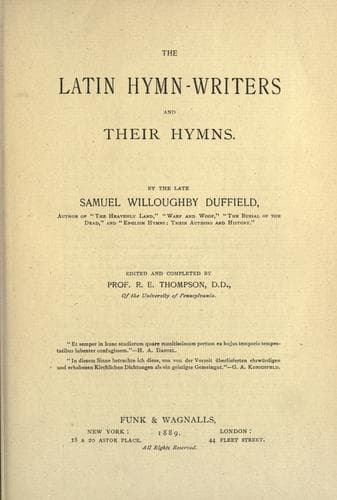
The Latin Hymn-writers and Their HymnsDuffield, Samuel Willoughby
Religion
The Latin Hymn-writers and Their Hymns
Duffield, Samuel Willoughby
Hymns, Latin -- History and criticism
It serves to illustrate the meshes which held the highest men of the
twelfth century together, when we encounter Peter the Venerable, Abbot
of Cluny. His true name was Pierre Maurice de Montboisier and he was
from Auvergne—“one of the noblest and most genial natures,” says
Morison, “to be met with in this or in any time.” What a fine old man he
was! Under him as abbot, Bernard of Cluny was prior, and the loving care
of Peter prepared an epitaph for that bravest and sweetest of singers.
It was he who bearded the other Bernard in his very den, and who came
out of many contests against that almost invincible ecclesiast with more
honor than before. Few could say this of a battle with the Abbot of
Clairvaux; and to no one but Peter does Morison, the biographer of
Bernard, concede any such victory.
It was also this admirable Peter who took Peter Abelard under his
protection. With a large and patient generosity he developed the better
nature of that headstrong, conceited, unhappy man; and when Abelard died
he wrote to Heloise the really warmhearted and tender letter, with a
great deal of humanity about it, which I have quoted already. And thus,
to whomsoever it may fall to consider the history of France in the
twelfth century; or of Abelard and the new philosophy; or of Bernard and
ecclesiastical polity; or of the other Bernard and the Latin hymns, it
is inevitable that the name of Peter the Venerable shall arise and stand
high above the throng of those by which he is surrounded.
His mother’s name was Raingarde, and her death, long after he had
attained his wide reputation, was deeply felt by him as that of one of
the best of women and dearest of mothers. For Pierre de Montboisier, in
those days when the stagnation and corruption of thought and morals were
not felt as they were felt later on, was a man as well as a monk. But
when, at last, the religious people became monks and not men; when they
were stupid, uninteresting, fat-fleshed and gross in life; when they had
no courage or piety; then they neither did the world any good nor made
their own souls ripe for heaven. And as sportsmen tell us that the
mellow “bob-o-link” ceases to sing and is only fit for slaughter when he
becomes the “rice bird” of the South, so it was with them. Latin
hymnology almost ceases to be interesting after this century. And Peter
the Venerable, while he wrote but little himself, is too fine a factor
in the arousing of others for us to forget him and his work.
Public-domain text, read in full here on John Shaqi.
Reviews
Reviews
No reviews yet
Be the first to share your thoughts on this work.
Elsewhere in the archive
Join the Discussion
Join the discussion
Sign in to leave a comment or review.
Sign InorCreate an account